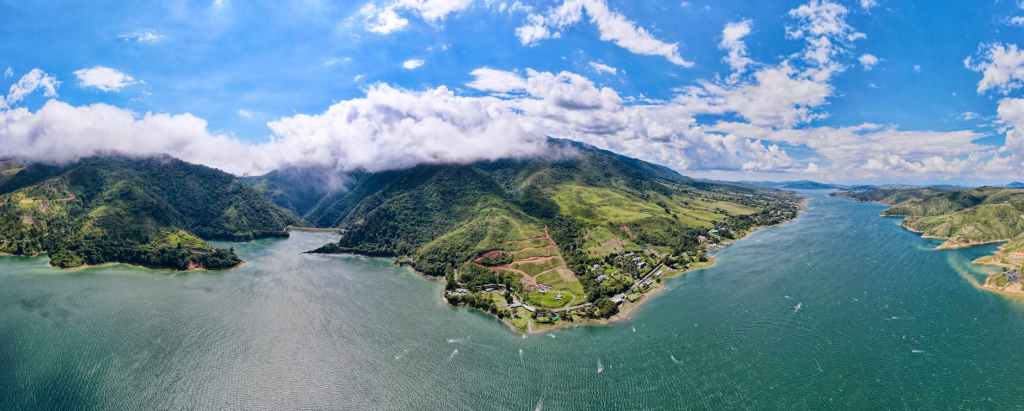
The ambitious infrastructure development project slated for the Great Nicobar Island has sparked widespread controversy and criticism over its potential environmental, legal, and ethical impacts, particularly concerning the island’s indigenous populations, the Shompen and Nicobarese communities.
The project, titled ‘Holistic Development of Great Nicobar,’ with an estimated cost of Rs 72,000 crore, is being spearheaded by the NITI Aayog and implemented by the Andaman and Nicobar Islands Integrated Development Corporation (ANIIDCO). Its scope includes the construction of an international container trans-shipment port, an international airport, a township, and a solar and gas-based power plant. However, concerns have been raised about the ecological risks posed by the project, such as the destruction of coral reefs, threats to wildlife habitats including the Nicobar Megapode bird and leatherback turtles, and overall disruption to the delicate marine and terrestrial ecosystems of the region.
Central to the controversy is the lack of consultation with the indigenous communities most affected by the project. The Shompen, classified as a Particularly Vulnerable Tribal Group (PVTG), and the Nicobarese, a Scheduled Tribe (ST), rely heavily on the forested areas and resources that are earmarked for development. Despite this, the draft Social Impact Assessment (SIA) report, a critical component under the Right to Fair Compensation and Transparency in Land Acquisition, Rehabilitation and Resettlement Act, 2013, has been completed without any input from these communities.
A public hearing held recently to discuss the SIA report did not include representation from the Shompen or Nicobarese communities. Instead, it focused on residents from mainland settlements established between 1968 and 1975, who would lose private land totaling 404.8 hectares for the infrastructure project. This exclusion has drawn sharp criticism from various quarters, including environmental experts, civil society organizations, and former civil servants who have termed the SIA process as ‘superficial’ and flawed.
The controversy deepens with allegations that the SIA failed to evaluate the impact on the original inhabitants of the island as mandated by law. The project’s proponents argue that the land slated for acquisition is government or revenue land, not tribal reserve, and therefore, tribal communities would not be directly impacted. However, critics argue that this stance overlooks the broader impact on indigenous livelihoods, cultural heritage, and rights under the A&N Islands Protection of Aboriginal Tribes Regulation (ANIPATR).
Moreover, the denotification of 84.10 sq km of tribal reserve area for the project has sparked further legal challenges, as it contradicts previous commitments to protect indigenous territories. The Tribal Council of Great Nicobar Island, which initially granted conditional approval for land diversion, later rescinded its consent, highlighting the complex and contentious nature of the project’s approval process.
The draft SIA report, prepared by Probe Research and Social Development Pvt Ltd., has come under severe scrutiny for its narrow definition of ‘local community’ and its failure to adequately assess the social costs and benefits of the project. The report suggests that the benefits of the infrastructure project will outweigh the negative impacts, citing improved community self-sustainability as a key positive outcome. However, critics argue that such assessments have ignored the cumulative impact on indigenous communities, whose displacement and loss of livelihoods could be irreversible.
In response to mounting criticism, a group of 103 former civil servants has petitioned various government bodies, including the ministries of Tribal Welfare and Home Affairs, urging a comprehensive review of the SIA. They advocate for a more inclusive assessment that incorporates inputs from anthropologists and other experts who can provide a nuanced understanding of the cultural and social dynamics at play in the Great Nicobar Island.
Environmentalists and legal experts have echoed these concerns, calling for adherence to international norms and domestic laws protecting indigenous rights and ecological sustainability. They argue that any development on the island must be conducted in consultation with and with the consent of the affected indigenous communities, as guaranteed by various national and international legal frameworks.
As the controversy surrounding the ‘Holistic Development of Great Nicobar’ project intensifies, all eyes are on the upcoming finalization of the SIA report on July 14. The report will undergo scrutiny by an expert committee comprising government officials, as well as experts from institutions like IIT Kharagpur and Tata Institute of Social Sciences (TISS). The outcome of this review process is expected to shape the project’s future trajectory and determine whether further legal challenges or environmental assessments will be required.
The Great Nicobar Island project stands as a stark example of the complex intersection between development ambitions, environmental conservation, and indigenous rights protection in India. The outcome of this debate will not only influence the fate of the island’s fragile ecosystems but also set precedents for future infrastructure projects across similar ecologically sensitive regions in the country.




 PARYAWARAN
Leave a comment