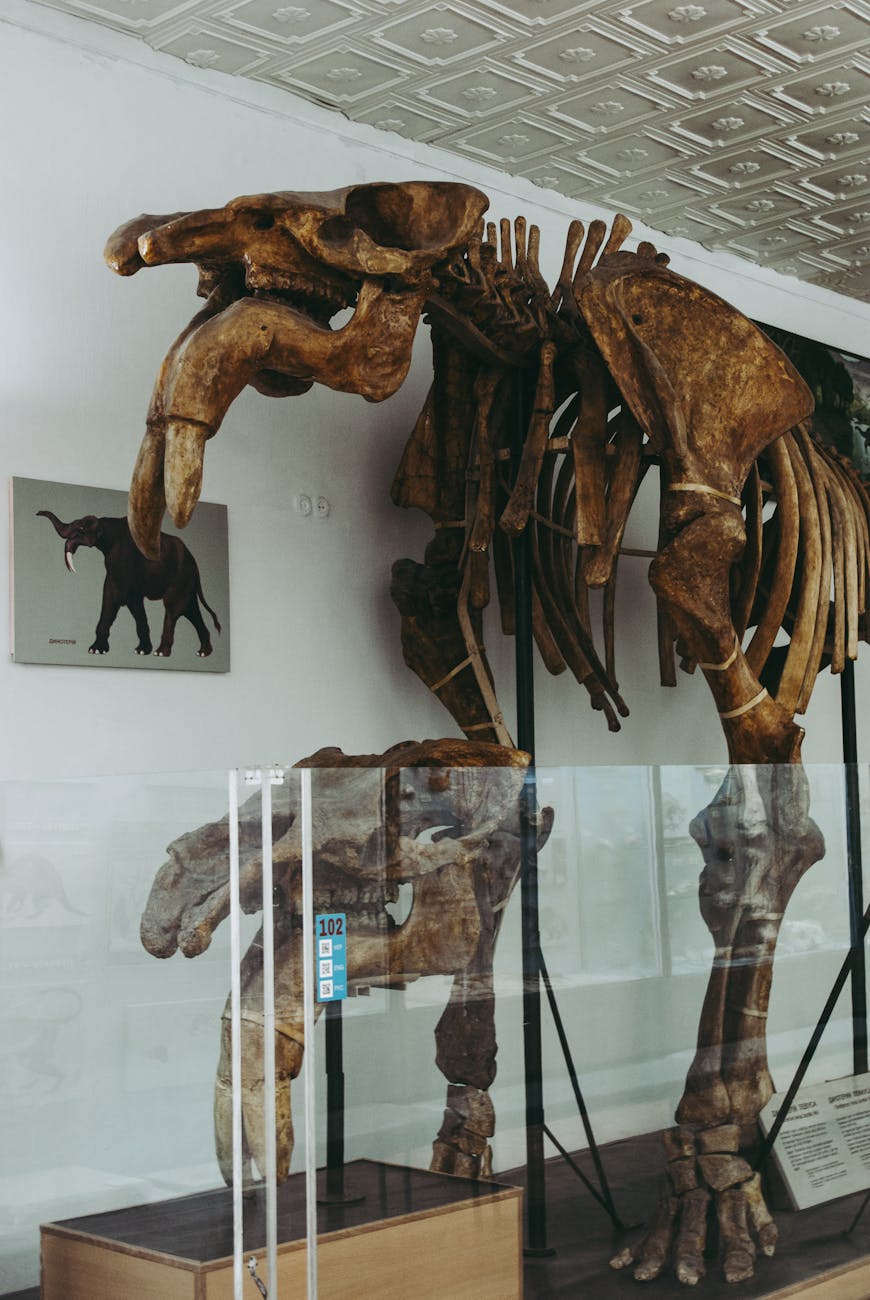
A remarkable discovery made two decades ago in the northern Indian Kashmir Valley is sending ripples through the scientific community as researchers seek to unlock its secrets. A giant fossil skull belonging to an extinct elephant has emerged as a key piece in understanding a complex chapter in elephant evolutionary history.
Dr. Ghulam Bhat from the University of Jammu spearheaded the excavation team that unearthed the skull alongside 87 stone tools, believed to have been utilized by prehistoric humans. This extraordinary find provides evidence of the interactions between early humans and these colossal creatures, suggesting a shared existence in a time long forgotten.
Recently, an international team of scientists, including experts from the Florida Museum of Natural History, the British Museum, the University of York, and the Natural History Museum, converged to examine the Kashmir skull in detail. Their aim is to shed light on the evolutionary path of the elephant family, particularly the Palaeoloxodon, commonly known as straight-tusked elephants, which are among the largest land mammals to have ever roamed the Earth.
Dr. Steven Zhang, a paleontologist at the University of Helsinki, remarked on the skull’s dimensions, stating, “From the general shape of the skull, it’s quite apparent that the elephant belonged to Palaeoloxodon. Full-grown adults easily stood around 4 meters tall at the shoulder and weighed 9 to 10 tons.” However, the absence of a thickened, forward-projecting crest—a hallmark of other Palaeoloxodon skulls previously discovered in India—has left researchers intrigued and questioning the classification of this specimen.
The evolutionary tree of elephants has seen ongoing debates about the significance of cranial features, particularly the crest, which is believed to develop more prominently as elephants mature. The Kashmir skull’s underdeveloped crest suggests it could represent a distinct species, diverging from those already known.
Dr. Zhang highlighted the importance of another obscure skull found in Turkmenistan during the 1950s, known as Palaeoloxodon turkmenicus. This specimen had puzzled scientists due to its similarity to the well-known European species P. antiquus but also its lack of a pronounced cranial crest. “The Turkmen skull’s features led many experts to question whether it was simply an aberrant individual of the European species,” he noted.
However, the discovery of the Kashmir skull has rekindled interest in the theory that it and the Turkmen specimen may represent a unique species that spanned a broad geographic area, from Central Asia to the northern Indian Subcontinent. Dr. Advait Jukar, lead author of the study and a researcher at the Florida Museum of Natural History, emphasized the significance of this discovery: “Now that we have the Kashmir skull, we can theorize a distinct species with a much broader distribution than previously understood.”
Dating techniques applied to the skull indicated it originated during the Middle Pleistocene period, approximately 300,000 to 400,000 years ago. This estimate aligns with the age of the Turkmen skull, further supporting the idea of a unique species that had not been fully recognized until now.
Investigations into the Palaeoloxodon lineage reveal that the species first evolved in Africa around one million years ago, characterized by a narrow, convex forehead and minimal skull crest development. In contrast, later specimens from Europe and India exhibited broader, flatter foreheads with prominent crests.
The researchers propose that P. turkmenicus could represent a crucial missing link in understanding the evolutionary transitions of these ancient megaherbivores. Their findings open the door to new inquiries into the lineage of elephants and the environmental adaptations that shaped their evolution.
As this thrilling saga of scientific discovery unfolds, the Kashmir elephant skull continues to promise new insights into the ancient history of these magnificent creatures, enriching our understanding of their journey through time. The study has been published in the Journal of Vertebrate Paleontology, contributing to the ever-evolving narrative of elephant evolution.



 PARYAWARAN
Leave a comment