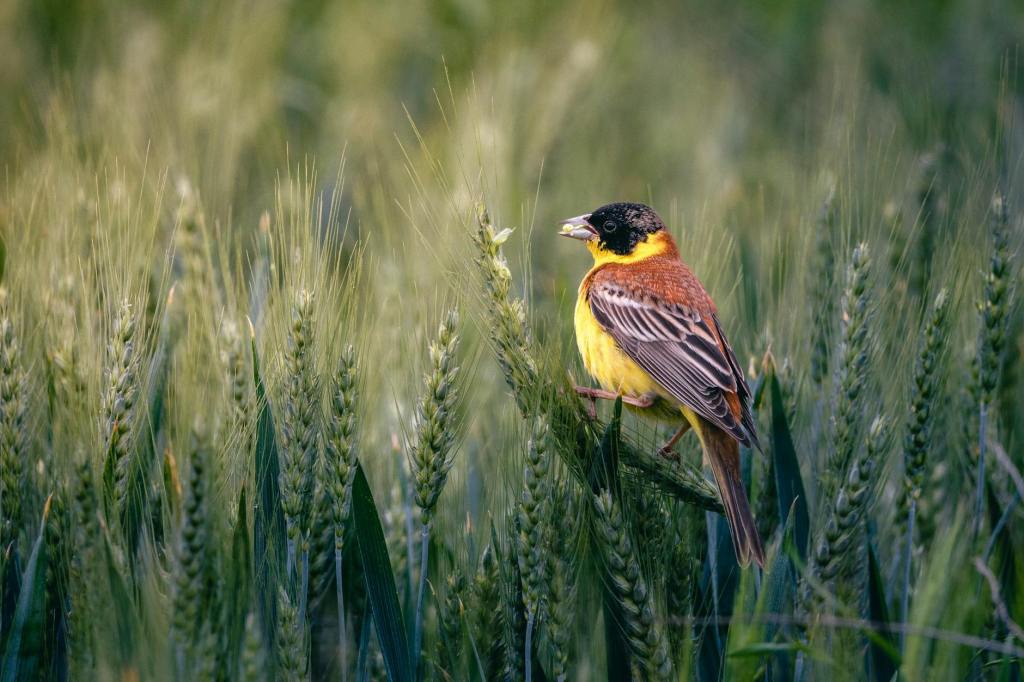
In a rare conservation success story amidst growing global concern over declining bird populations, agricultural landscapes in Nepal are emerging as crucial wintering habitats for the Critically Endangered Yellow-breasted Bunting (Emberiza aureola), once considered one of the most abundant songbirds across Eurasia. A recent multi-year study has revealed that these farmlands—often overlooked in conservation planning—are now offering vital refuge to a species on the brink of extinction.
Once widespread from Finland to Japan, the Yellow-breasted Bunting has faced a dramatic population collapse in recent decades, primarily driven by large-scale illegal trapping and trade, particularly during migration and in wintering areas across South and Southeast Asia. In Nepal, however, the species appears to be making a modest recovery, thanks largely to the relatively less-intensified, diverse agricultural landscapes that still dominate much of the country.
Between 2015 and 2023, researchers documented 85 sightings of the Yellow-breasted Bunting across 22 districts in Nepal. Remarkably, the majority of these records—79%—came from agricultural lands, with grasslands accounting for 14% and wetlands making up the remaining 7%. Perhaps most significantly, the species was predominantly found outside of protected areas, underscoring the growing importance of community-managed and working landscapes in species conservation.
The 2022/2023 winter population was estimated at 2,120 individuals, marking a promising 43% increase from the previous year. The findings suggest that Nepal may be playing a pivotal role in the survival of the species during its non-breeding season.
“These results challenge the conventional wisdom that agriculture is universally detrimental to bird life,” said one of the lead researchers. “In the case of the Yellow-breasted Bunting, traditional and heterogeneous farming systems in Nepal provide essential food and roosting sites, especially in winter.”
The study also investigated fine-scale habitat preferences of the species and found that buntings commonly forage in both standing crops and fallow fields. Roosting behavior was closely tied to specific vegetation types, particularly sugarcane (Saccharum officinarum) and reed grasses such as Saccharum spontaneum and Phragmites karka, which are found across agricultural, grassland, and wetland ecosystems. Using habitat modeling techniques, researchers identified crop cover and grass height as the strongest predictors of Yellow-breasted Bunting abundance.
The research carries significant implications for conservation policy in the region. Because most sightings occurred outside protected areas, conservation strategies that focus solely on formal reserves may overlook key habitats for this and other migratory species. Instead, researchers advocate for a broader, landscape-scale approach that integrates habitat management with local farming practices.
“Farmer engagement is absolutely critical,” emphasized the research team. “By working with communities to promote awareness and sustainable land use, we can turn these agricultural areas into safe havens for wildlife.”
To translate research into action, the study recommends regular monitoring of population trends and habitat use to inform adaptive conservation strategies. Conservationists are also calling for targeted awareness campaigns to educate farmers about the ecological importance of the Yellow-breasted Bunting and the specific threats it faces, including illegal trapping along its migratory route.
In recent years, there has been growing recognition globally of the potential role that working landscapes can play in biodiversity conservation. This study offers a compelling case from South Asia, where traditional farming systems may still provide the structural diversity and seasonal resources required by many declining species.
As pressures from urbanization and agricultural intensification continue to mount, Nepal’s farmlands now stand as critical frontlines in the fight to save one of the world’s most endangered migratory birds. With coordinated efforts between researchers, farmers, and conservation practitioners, there is hope that the melodic calls of the Yellow-breasted Bunting will not be silenced forever.




 PARYAWARAN
Leave a comment