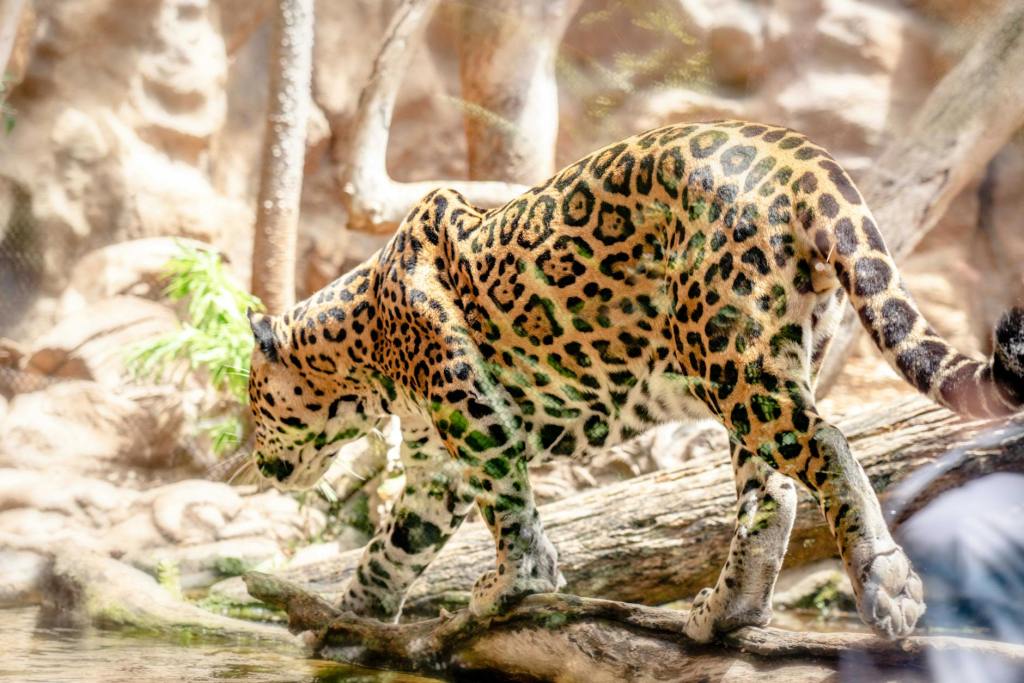
A global study involving researchers from UBC Okanagan has uncovered striking differences in how wild members of the dog and cat families move through their habitats. The findings, published in Proceedings of the National Academy of Sciences, reveal that canids—such as wolves, foxes, and coyotes—tend to follow dense, predictable routes across their territories, while felids—like cougars, leopards, and lynx—roam more freely and less predictably.
By analyzing GPS data from over 1,200 individual animals representing 34 species across six continents, the study provides one of the most comprehensive insights to date into the contrasting spatial behaviors of these two major carnivore families. Researchers employed physics-based models to map what they call “routeways”—the lines of travel that animals frequently reuse. These models revealed that canids consistently reused the same paths, while felids demonstrated more scattered and less repetitive movement patterns.
On average, canids displayed 15 to 33 percent more routeways than their feline counterparts, even in similar habitats. This consistent divergence in movement strategy, observed globally, suggests that the differences are deeply rooted in evolutionary history. The evolutionary split between the two families occurred around 45 million years ago, and this study highlights how that divergence continues to influence their behavior today.
The researchers attribute the difference in movement to various ecological and behavioral factors. Canids are generally omnivorous, highly social, and chase-oriented predators. These characteristics lend themselves to strategic route reuse, as coordinated travel can support pack hunting, territory marking, and resource discovery. In contrast, felids tend to be solitary, stealth-based predators with strict carnivorous diets, allowing them to move more independently through their environments without relying on fixed paths.
This behavioral distinction also aligns with differences in spatial memory and navigation. While the study did not directly assess intelligence, it reinforces previous research suggesting that canids possess stronger spatial working memory. This memory likely supports their ability to remember and reuse specific travel paths, whereas felids appear to rely more on flexible spatial awareness, perhaps to adapt more easily to unpredictable prey or varied landscapes.
Beyond the academic insights, the study holds significant implications for conservation planning. The predictable movement patterns of canids make them particularly vulnerable to human-made barriers such as roads, fences, and industrial infrastructure. At the same time, their route fidelity also means they can benefit more readily from wildlife corridors and crossings, which reconnect fragmented habitats.
Felids, on the other hand, are less likely to use a single path repeatedly, making it more difficult to design effective conservation infrastructure for their needs. Their diffuse movement patterns may make them less susceptible to localized disruptions but can also challenge efforts to protect core habitats or establish migration routes. These nuances are particularly important in areas where human development intersects with wildlife territory.
In Canada, especially in provinces like British Columbia and Alberta, the construction of seismic lines and forestry roads has been shown to facilitate canid movement, which can indirectly increase pressure on vulnerable prey species such as caribou. Understanding the movement behaviors of both predators and prey is essential for managing these impacts and implementing sustainable land-use strategies.
The study is also a milestone for interdisciplinary and collaborative science. UBC Okanagan’s contribution was part of a broader effort involving biologists, physicists, and statisticians, working alongside more than 100 international collaborators. By integrating tools from physics with ecological data, the researchers were able to uncover movement patterns that transcend individual species or ecosystems.
The project was made possible through extensive global data sharing. GPS tracking of large carnivores is a resource-intensive process, often costing tens of thousands of dollars per animal. The willingness of researchers worldwide to pool data allowed for an unprecedented scale of analysis, enhancing the study’s reliability and applicability.
Ultimately, this research showcases how long-term evolutionary adaptations continue to shape the behavior of modern wildlife and underscores the importance of understanding those behaviors for effective conservation. As human activity increasingly intersects with natural habitats, recognizing the distinct movement patterns of species like wild dogs and cats will be crucial for preserving biodiversity and ecosystem balance.
The study highlights not only differences in biology and behavior but also the need for tailored conservation approaches. While canids and felids may share the public’s imagination—and even their living rooms in the form of pets—their wild relatives operate under fundamentally different rules, shaped by millions of years of evolution.



 PARYAWARAN
Leave a comment