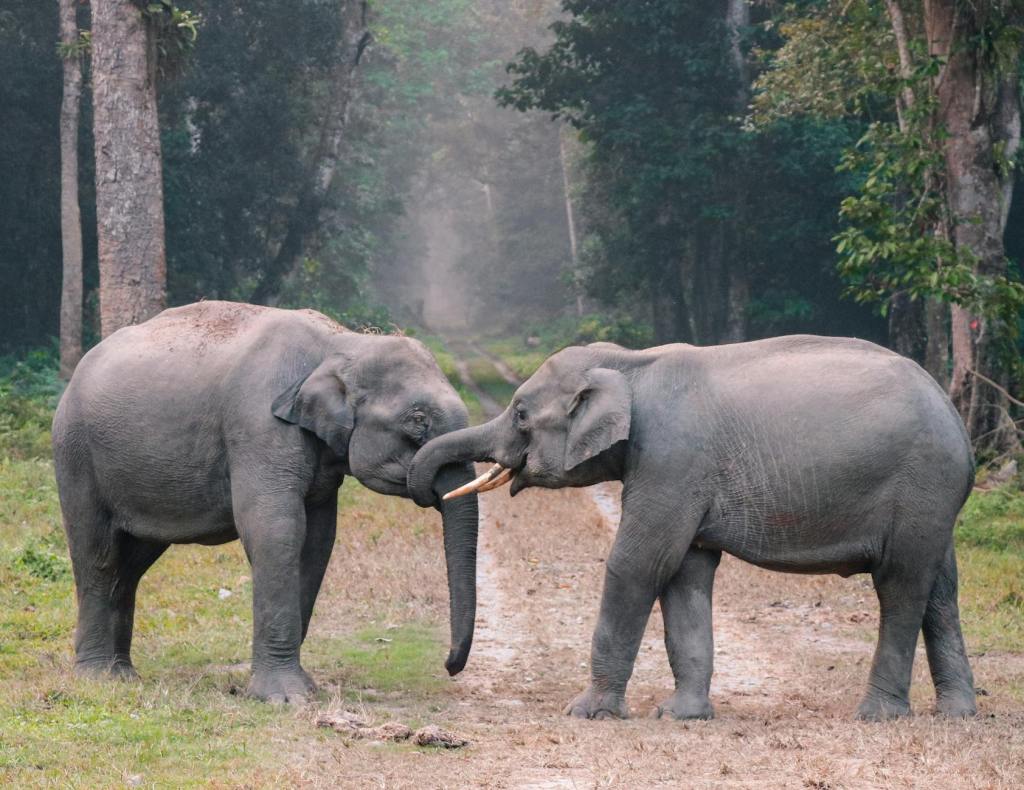
India’s wild elephant population has declined by nearly 18% in eight years, according to the country’s first-ever DNA-based population estimation, raising serious concerns about the future of one of India’s most iconic species and a keystone of its forest ecosystems.
The All-India Synchronous Elephant Estimation (SAIEE) 2025, conducted jointly by the Union Environment Ministry, Project Elephant, and the Wildlife Institute of India (WII), has pegged the population at 22,446 elephants, a steep fall from 27,312 in 2017. The report, released on Tuesday after a four-year delay, marks a turning point in the scientific monitoring of India’s elephants — but also highlights the mounting pressures facing the species.
Officials attributed the delay to the complex DNA fingerprinting and validation process, which involved analyzing over 21,000 dung samples collected from elephant landscapes across India. The study used genetic identification to track individual elephants — a method considered far more accurate than traditional head counts — and combined it with satellite-based mapping and field surveys to produce a comprehensive population estimate.
The exercise covered an extraordinary 6.7 lakh km of forest trails and mapped 3.1 lakh dung plots, leading to the identification of 4,065 unique elephants through genetic markers. Using a mark-recapture statistical model, scientists arrived at an estimated national population range between 18,255 and 26,645, with an average of 22,446.
Western Ghats Remain Stronghold, But Declines Elsewhere Deepen
Regionally, the Western Ghats remain the largest refuge, sheltering 11,934 elephants, followed by the North Eastern Hills and Brahmaputra floodplains with 6,559. The Shivalik Hills and Gangetic plains support 2,062 elephants, while Central India and the Eastern Ghats together hold 1,891.
Among states, Karnataka continues to host the largest number of elephants at 6,013, followed by Assam (4,159), Tamil Nadu (3,136), Kerala (2,785), and Uttarakhand (1,792). However, declines have been noted in several regions — most notably Kerala, where numbers have fallen sharply due to habitat loss and increased human-elephant conflict.
Smaller and more fragmented populations persist in Odisha (912), Chhattisgarh and Jharkhand (over 650 combined), and the northeastern states of Arunachal Pradesh (617), Meghalaya (677), Nagaland (252), and Tripura (153). States like Madhya Pradesh (97) and Maharashtra (63) now have only isolated herds, raising fears of local extinctions.
Shrinking Habitats and Rising Conflict
Conservationists say the results are a sobering reminder that India’s elephants — which represent over 60% of the global Asian elephant population — are facing intensifying threats from habitat loss, linear infrastructure, and encroachment. Expanding railways, highways, and mining projects have fragmented traditional corridors, forcing elephants into human-dominated landscapes and triggering an escalation in conflict incidents.
“An 18% decline in less than a decade is a red flag,” said a senior wildlife biologist involved in the study. “Even though the new DNA-based approach provides a more accurate picture, it also confirms what field ecologists have feared — that India’s elephant habitats are shrinking faster than our ability to protect them.”
A New Baseline — and a Wake-Up Call
Officials say the 2025 estimation establishes a scientific baseline for future monitoring and conservation planning under Project Elephant. The report emphasizes the need for corridor restoration, conflict mitigation, and stricter land-use regulation to ensure long-term survival of wild elephant populations.
Yet, experts warn that without urgent intervention, India could witness further fragmentation of its elephant populations, leading to loss of genetic diversity and irreversible ecological consequences.
As India’s most intelligent and socially complex mammals continue to navigate shrinking habitats, the findings serve as both a milestone in wildlife science and a warning signal — that even with advanced technology, conservation success depends on political will and coexistence on the ground.



 PARYAWARAN
Leave a comment