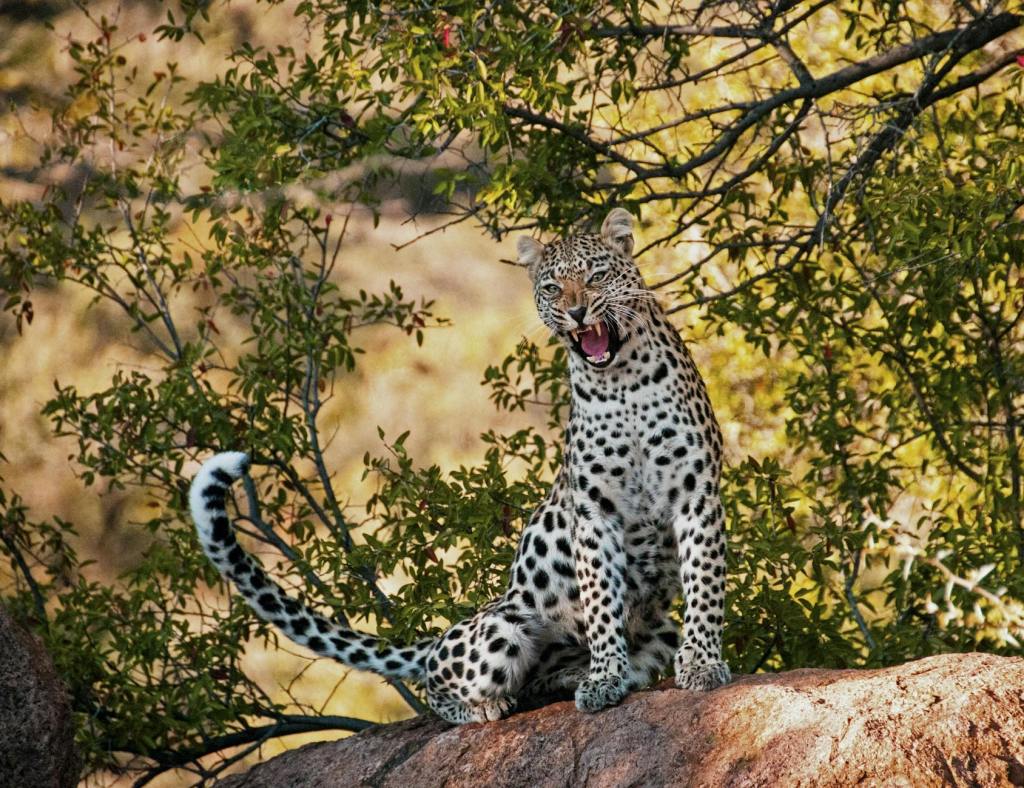
In a rare and significant addition to India’s wildlife records, conservationists have documented an ultra-rare leopard colour morph in Karnataka’s Vijayanagara district, marking the first confirmed sighting of its kind in the state. The unique animal has been named the “Sandalwood Leopard,” a term that reflects both its distinctive appearance and the cultural heritage of Karnataka.
The discovery was made by conservation biologist and leopard expert Sanjay Gubbi and his team from the Holématthi Nature Foundation (HNF) through systematic camera trapping. The leopard, a female estimated to be six to seven years old, displays a striking pale reddish-pink coat with light brown rosettes—dramatically different from the typical tawny coat with black rosettes seen in most leopards (Panthera pardus).
Internationally, leopards with this unusual coloration are often referred to as “Strawberry leopards.” However, such individuals are exceedingly rare worldwide, with only sporadic records from South Africa and a single documented case from Tanzania. The Vijayanagara sighting represents only the second confirmed record of this colour morph in India, following the documentation of a similar individual in Rajasthan’s Ranakpur region in November 2021.
According to HNF, the unusual coloration is believed to arise from a rare genetic variation. It may involve either an excess of red pigmentation, known as erythrism, or a reduction in dark pigmentation, referred to as hypomelanism. However, researchers have emphasized that while photographic evidence clearly establishes the leopard as a rare colour morph, definitive identification of the precise genetic mechanism would require molecular analysis.
“At present, the assessment is based on visual characteristics captured through camera traps,” Sanjay Gubbi noted in a statement. “To conclusively determine the genetic basis, DNA analysis from non-invasive samples such as scat or hair would be necessary. Until such evidence is available, it is scientifically appropriate to describe this animal as a rare colour morph rather than assign a specific genetic condition.”
One of the camera trap images also captured the Sandalwood Leopard alongside a cub with normal coat coloration and distinct black rosettes. This observation highlights that the colour morph does not necessarily pass on visibly to offspring and underscores the complexity of genetic expression in wild populations.
In India, the most commonly observed leopard colour variant remains the melanistic or black leopard, particularly prevalent in forested landscapes such as the Western Ghats. Compared to melanism, the Sandalwood Leopard represents an exceptionally rare phenomenon, making its documentation particularly significant for conservation science.
The camera trapping exercise forms part of HNF’s broader efforts to estimate leopard populations and identify critical landscapes for large mammal conservation in the Kalyana-Karnataka region.
Despite being under-studied from a wildlife conservation perspective, the Kalyana-Karnataka region holds considerable potential for the protection of arid and semi-arid species. These include the Indian grey wolf, striped hyena, and Bengal fox, all of which rely on mosaic landscapes that are often overlooked in mainstream conservation planning.
HNF’s long-term research indicates that Karnataka supports an estimated population of around 2,500 leopards, making it one of the key strongholds for the species in India. The Foundation’s work has also led to several notable discoveries in the state, including the first-ever documentation of the honey badger, the identification of a white colour morph of wild dogs, and important range extensions of species such as chinkara, dhole, and brown mongoose.
The documentation of the Sandalwood Leopard not only adds to the growing understanding of leopard diversity but also underscores the ecological value of lesser-studied landscapes. Conservationists say such findings reinforce the need for sustained research and protection efforts beyond well-known wildlife reserves, ensuring that rare genetic variations and the ecosystems that support them are conserved for the future.


 PARYAWARAN
Leave a comment