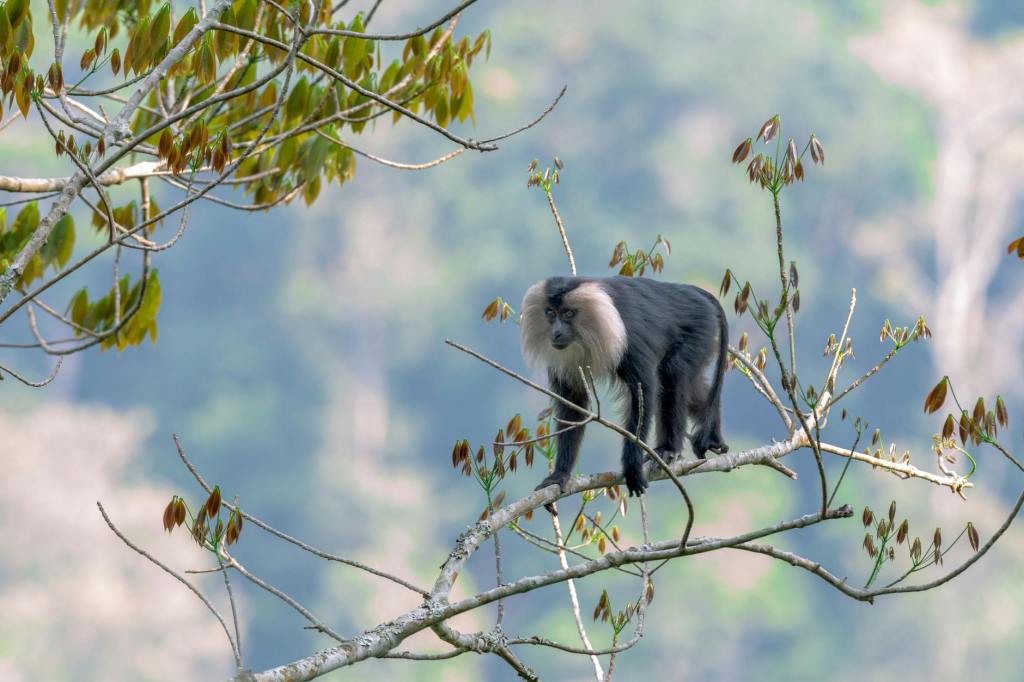
Once the face of one of India’s most powerful environmental victories, the lion-tailed macaque is again fighting for survival in the rainforests of the Western Ghats. The primate that helped save Silent Valley from destruction now stands vulnerable, its future uncertain amid growing pressure on the forests it calls home.
Silent Valley in Kerala entered the national consciousness in the 1970s, when plans for a hydroelectric dam on the Kunthipuzha river threatened to submerge vast stretches of untouched evergreen rainforest. The area was among the last strongholds of the lion-tailed macaque, a species found nowhere else in the world. A broad-based movement emerged, bringing together scientists, students and local communities who argued that the loss of the forest would mean the loss of an entire ecosystem. Their efforts culminated in 1983, when the project was cancelled and Silent Valley was declared a national park, setting a precedent for conservation in India.
For years, the macaque stood as a symbol of what determined public action could achieve. Easily recognised by its jet-black coat, pale mane and lion-like tail tuft, it came to represent the delicate balance of life in the Western Ghats. Today, that balance is under strain. While older estimates placed the species’ population at over 3,000 individuals, newer studies suggest that fewer than 2,500 remain, scattered across a landscape increasingly divided by human activity.
Unlike many adaptable primates, the lion-tailed macaque is a strict rainforest specialist. It lives almost entirely in the canopy of tropical evergreen forests, feeding on fruits, leaves, insects and small animals. As a key seed disperser, it plays an important role in maintaining forest health. When forests are fragmented by plantations, highways or tourist infrastructure, the macaques are forced into smaller, isolated patches where survival becomes more difficult and genetic diversity declines.
Recent coordinated surveys by forest departments in Kerala and Tamil Nadu have begun to fill critical gaps in knowledge. Silent Valley continues to host the largest known population, while smaller groups persist in the Anamalai, Nelliampathy and Agasthyamalai ranges. In Karnataka, remnants survive near Kudremukh and the Sharavathi valley, and in Tamil Nadu, isolated troops inhabit the Kalakkad-Mundanthurai Tiger Reserve. Despite these efforts, the absence of a comprehensive, up-to-date estimate of breeding adults underscores how challenging it remains to study a species that moves silently through dense rainforest canopies.
The macaque’s survival has also been shaped by its deep cultural ties to forest communities. Known locally as kattu kurangu, it is often seen as a guardian of the forest and a symbol of continuity between people and nature. Its calls at dawn and dusk are woven into local beliefs, while in plantation landscapes such as Valparai, workers view encounters with the species as signs of good fortune and seasonal stability.
This relationship has helped drive grassroots conservation solutions. In fragmented landscapes, canopy bridges now span roads and power lines, allowing macaques to cross safely without descending to the ground. Forest officials and local groups are identifying additional sites where such structures could reconnect broken habitats. Increased awareness has also encouraged safer driving practices in forested areas, reducing accidental deaths.
Today, conservation strategies are becoming more targeted. Genetic mapping is being used to identify the most isolated groups, while calls grow louder for restoring forest corridors, strengthening legal protection and managing tourism responsibly. Community-based eco-tourism initiatives have brought renewed attention to the species, linking livelihoods with conservation.
The lion-tailed macaque once united people to save a forest. Whether it continues to survive will depend on renewing that commitment—not just to a charismatic primate, but to the living rainforest that sustains it.




 PARYAWARAN
Leave a comment