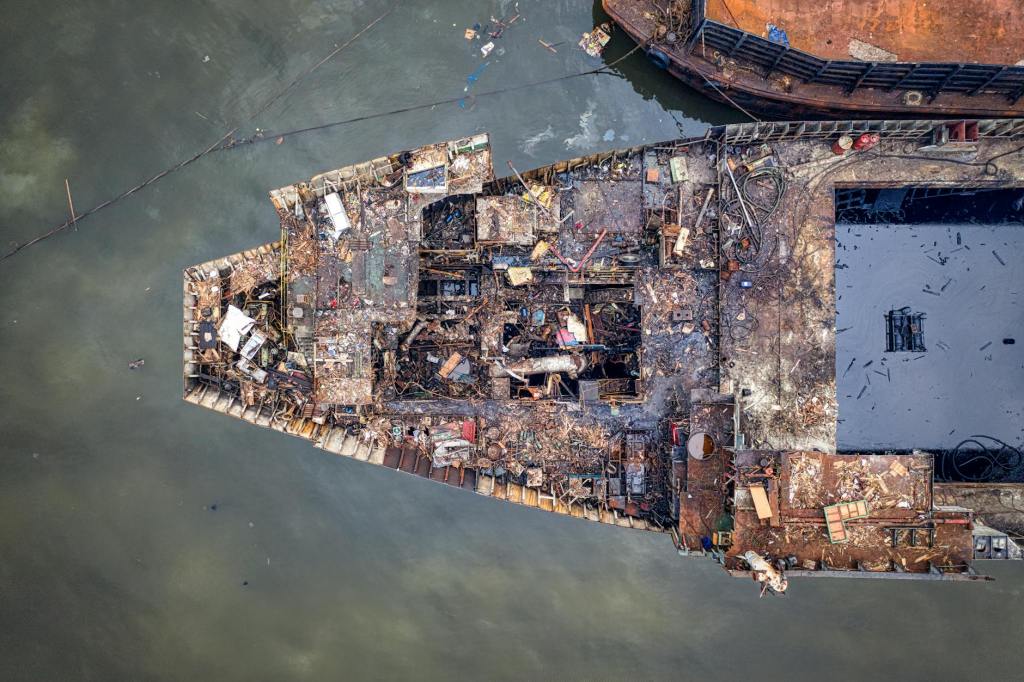
Along the tidal flats of South Asia’s coastline, the end of a ship’s life is often as dramatic as its decades at sea. On the beaches of Bangladesh, India and Pakistan, enormous vessels are deliberately run aground and torn apart piece by piece, supplying steel to global markets but leaving behind a trail of pollution, injuries and social costs. Despite new international safety rules, environmental groups say the industry continues to shift hazardous waste and risk from wealthy nations to poorer coastal communities.
At the heart of concern is the practice known as “beaching,” in which ships are driven at high tide onto mudflats and dismantled manually. The method is cheap and requires little infrastructure, making it attractive to shipowners seeking to minimize costs. But it also exposes workers and ecosystems to toxic materials embedded in aging vessels.
According to recent data from a Brussels-based non-governmental organization that monitors ship recycling, the vast majority of the world’s scrapped ships still end up on just a handful of South Asian beaches. Last year, when measured by weight, roughly 85 percent of dismantled ships were broken on shores in Bangladesh, India and Pakistan. In total, more than 300 vessels were scrapped globally in 2025, with South Asia accounting for well over half.
The industry has long been described by international labor bodies as among the most dangerous forms of work. Workers often cut through steel hulls with minimal protective gear, facing risks from falling plates, explosions from trapped gases and exposure to hazardous substances. Many ships contain heavy metals, asbestos, toxic paints and even traces of radioactive materials. While reusable fuel and oil are typically siphoned off for resale, residues frequently seep into coastal waters.
Environmental damage extends beyond the shoreline. Tidal movements can disperse pollutants into the Bay of Bengal, where toxins settle into sediments and enter the marine food chain. Researchers and advocacy groups have reported declining reproductive rates in some marine species and the disappearance of others in heavily affected areas. Coastal vegetation has also suffered. Large stretches of mangroves—natural storm barriers and important carbon sinks—have reportedly been cleared to expand shipbreaking yards, increasing the vulnerability of nearby villages to flooding and storm surges.
For coastal communities, shipbreaking brings both income and hardship. The industry provides jobs in regions where economic opportunities are limited, drawing workers from rural areas with little formal education. Many are initially drawn by the scale and spectacle of the ships, but the dangers quickly become apparent. Serious injuries, amputations and chronic illness are common. Asbestos exposure, in particular, has been linked to long-term respiratory disease and cancers. Advocacy groups document dozens of injuries and multiple deaths each year, though underreporting is believed to be widespread.
Accounts from affected communities describe villages where a noticeable number of men live with permanent disabilities. Families can fall into poverty when a primary earner is injured or killed. Without strong social safety nets, injured workers may struggle to support themselves.
International efforts to regulate the sector have intensified in recent years. A global convention aimed at improving ship recycling standards entered into force in 2025, setting requirements for safer and more environmentally sound practices. However, critics argue that loopholes allow substandard operations to continue. They say some facilities receive approval on paper while conditions on the ground remain largely unchanged.
Another challenge is the practice of “flag hopping,” where shipowners change a vessel’s registration to countries with weaker oversight before sending it for dismantling. This can help owners sidestep rules tied to a ship’s original flag state. Environmental groups argue that such maneuvers undermine international agreements governing hazardous waste and ship recycling.
Ownership structures can also be opaque, involving layers of intermediaries and offshore entities. This makes it difficult to hold companies accountable for conditions at the end of a ship’s life. Campaigners describe a system marked by double standards, in which profits are captured elsewhere while environmental and human costs are concentrated in vulnerable regions.
Recycling advocates note that safer alternatives exist, including dry-dock recycling with proper waste management and worker protections. These methods are more expensive but can significantly reduce pollution and accidents. Some countries outside South Asia have invested in such facilities, though global capacity remains limited.
For now, the beaches of South Asia remain central to the global shipbreaking trade. Old vessels continue to arrive, carrying with them layers of toxic materials from decades of operation. As long as dismantling ships on open shores remains the cheapest option, observers say, the pressure on these coasts and communities is unlikely to ease.
The debate over shipbreaking has thus become part of a larger conversation about environmental justice and global inequality. Critics argue that without stricter enforcement, greater transparency and a shift away from beaching, the world’s maritime industry will continue to externalize its dirtiest burdens onto those least equipped to bear them.




 PARYAWARAN
Leave a comment