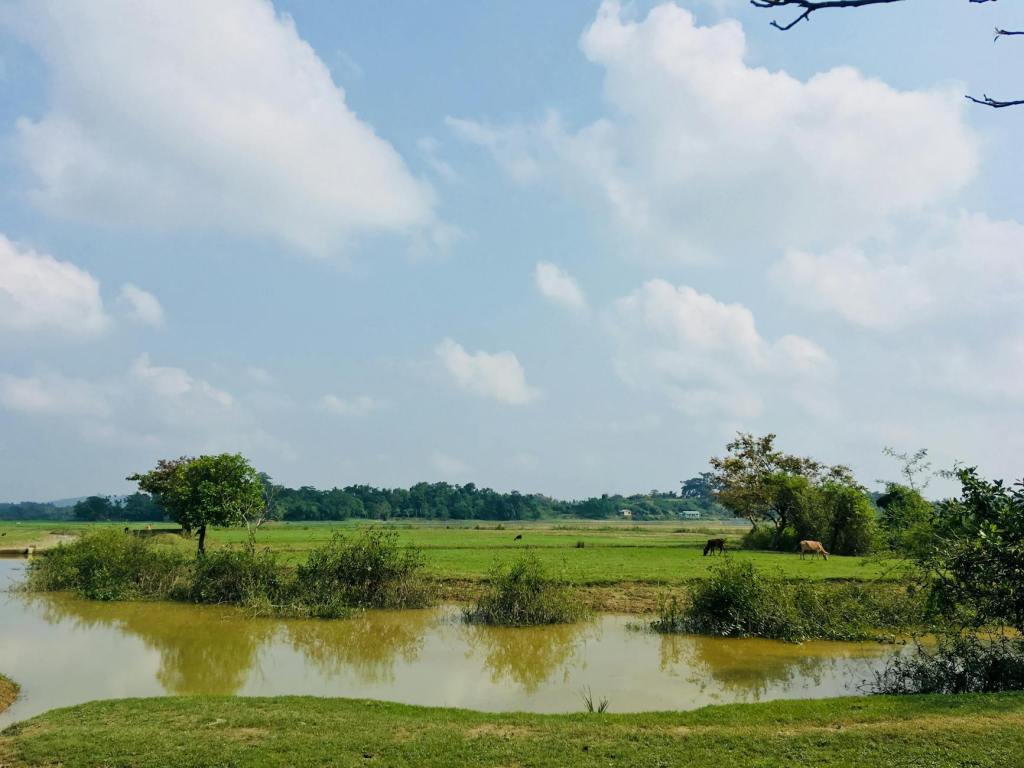
Large mammals are thriving across the agricultural plains of India’s Deccan Peninsula, overturning long-standing assumptions that wildlife survival depends primarily on protected forests and national parks. A new study published in the journal Ecology and Evolution reveals that so-called “wastelands” — open, sparsely wooded areas frequently earmarked for industrial development or large-scale afforestation — serve as vital habitats for several iconic and threatened species.
The research focused on Koppal district in Karnataka, a semi-arid region dominated by agriculture, grazing lands and scrub ecosystems. Despite heavy human use, scientists found widespread presence of species such as the striped hyena, sloth bear, blackbuck and Indian grey wolf. The findings suggest that human-dominated landscapes can sustain substantial wildlife populations when ecological features remain intact.
The study was conducted by researchers affiliated with the Ashoka Trust for Research in Ecology and the Environment, the National Centre for Biological Sciences and the Deccan Conservation Foundation. Together, the institutions sought to evaluate how large carnivores and herbivores use open habitats outside formal protected areas.
India’s wastelands, a government classification often applied to open scrublands, grasslands and rocky outcrops lacking dense tree cover, have historically been viewed as ecologically unproductive. As a result, such areas are frequently targeted for industrial corridors, infrastructure expansion, renewable energy projects and tree-planting drives. However, ecologists have increasingly argued that these landscapes support unique biodiversity adapted to open ecosystems.
Rather than relying solely on conventional wildlife survey tools such as camera traps — which can be challenging to deploy in heavily used landscapes due to theft risks or privacy concerns — the researchers adopted an innovative approach rooted in local knowledge. They worked closely with nomadic pastoralist communities whose members traverse the terrain daily while herding livestock.
Through hundreds of structured interviews, pastoralists provided detailed observations of wildlife sightings, movement patterns and habitat use. These communities, with deep familiarity with the landscape, offered insights that allowed researchers to map species presence across large areas that would otherwise be difficult to survey systematically.
To ensure scientific robustness, the team employed occupancy modelling, a statistical framework that estimates the probability of species presence while accounting for imperfect detection. This method recognises that an animal may inhabit an area even if it is not observed during a specific survey period. Researchers also incorporated validation measures by asking respondents to distinguish between similar-looking species, such as wolves and jackals, using paired photographs. This cross-verification strengthened confidence in the data’s accuracy.
The results were striking. Striped hyenas were estimated to occupy 52 percent of the surveyed landscape. The Indian grey wolf showed even broader distribution, with an estimated presence across 76 percent of the region. Blackbucks, a native antelope species once widespread across the subcontinent, were found in 63 percent of the study area. Sloth bears were also recorded in multiple locations.
These findings challenge the dominant conservation model that prioritises fenced reserves and forested habitats. Instead, the study underscores the importance of land-sharing approaches in which wildlife and human livelihoods coexist within multifunctional landscapes. Open ecosystems, often dismissed as degraded or marginal, appear to play a crucial role in sustaining wide-ranging mammals that require large territories.
The research arrives at a critical moment for land-use planning in India. As the country accelerates efforts to expand renewable energy infrastructure and implement large-scale afforestation to meet climate commitments, open lands are frequently selected for development due to their classification as underutilised. Wind farms, solar parks and monoculture plantations are increasingly common in these areas.
Conservation scientists caution that converting scrublands and grasslands into industrial or tree-covered zones may inadvertently displace species adapted to open habitats. Unlike forest-dwelling animals, species such as wolves and blackbucks depend on visibility and expansive terrain for foraging and predator avoidance. Transforming these environments could fragment habitats and disrupt ecological networks.
The study advocates for recognising the ecological value of working landscapes where agriculture and pastoralism coexist with wildlife. By integrating biodiversity considerations into development planning, policymakers can avoid misclassifying ecologically rich areas as empty or expendable.
Researchers argue that inclusive conservation strategies must account for both biodiversity and rural livelihoods. Pastoralist communities not only depend on these lands economically but also contribute knowledge that can enhance wildlife monitoring and management.
The findings suggest that safeguarding India’s biodiversity will require moving beyond a narrow focus on forest cover and protected areas. Instead, protecting the country’s open ecosystems — long labelled as wastelands — may prove essential for the survival of some of its most emblematic large mammals.



 PARYAWARAN
Leave a comment