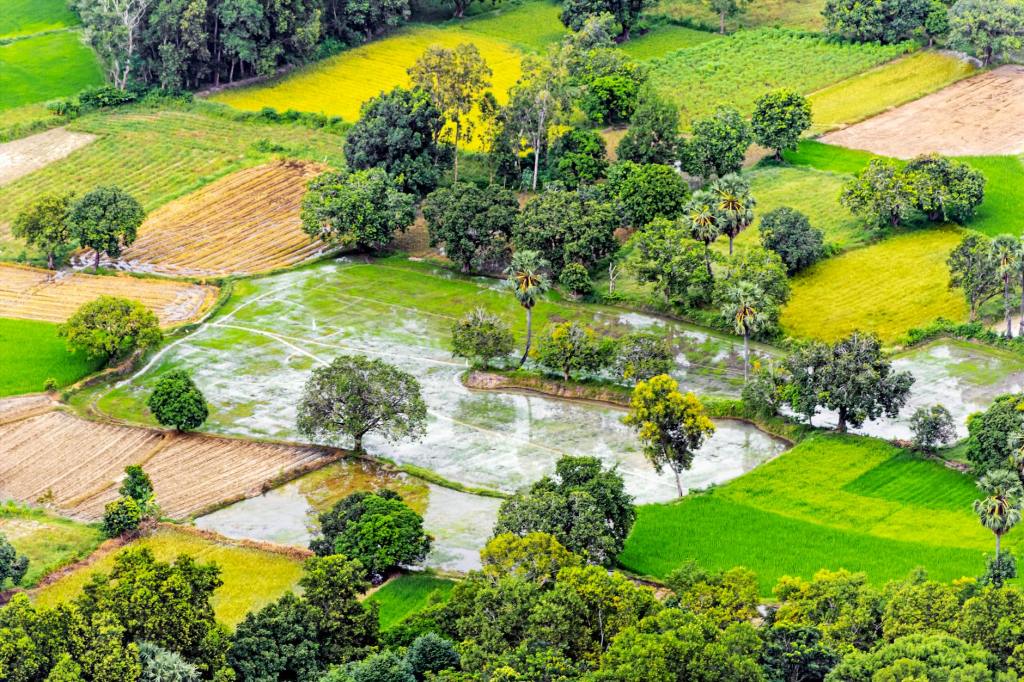
A growing body of research is challenging long-held assumptions about conservation in fragmented landscapes, revealing that even a small number of trees on farmland can play a critical role in supporting wildlife. A new global study has found that scattered trees across agricultural land can significantly enhance biodiversity, particularly for bird species, offering a practical pathway to balance farming and conservation.
The findings emerge from research conducted across tropical regions, including the Amazon, as well as parts of Africa and Asia, where forests have increasingly been broken up into smaller patches due to expanding agriculture. Traditionally, conservation efforts have focused on preserving large, continuous forest areas or ensuring that smaller forest patches remain close to one another. However, the new study highlights that what lies between these patches may be just as important.
Researchers compared bird diversity in two types of fragmented landscapes: forest patches surrounded by farmland and isolated forest islands formed in reservoirs after rivers were dammed. Despite being similar in size, the forest patches embedded in farmland supported a far greater number of bird species—especially when the surrounding agricultural land contained trees.
The presence of trees within farmland appears to create a more hospitable environment for wildlife. These scattered trees can provide food, shelter, and stepping stones that allow birds and other species to move between forest patches. As a result, landscapes that might otherwise act as barriers to wildlife instead become permeable and supportive ecosystems.
The study’s scale adds weight to its conclusions. A collaboration involving dozens of scientists analyzed data from more than 1,000 forest fragments and tracked nearly 2,000 bird species. Using a combination of field surveys, acoustic monitoring, and satellite imagery, the researchers were able to capture a detailed picture of how biodiversity responds to different landscape conditions.
One of the most striking findings was that forest fragments surrounded by tree-rich farmland could host more than twice as many bird species as similarly sized forest islands in reservoirs. This suggests that improving the quality of the surrounding landscape can be just as effective as increasing the size of protected areas.
The implications for conservation policy are significant. In many parts of the world, especially in developing regions, expanding agricultural land is unavoidable due to growing food demands. Rather than viewing farmland and conservation as competing priorities, the study points to the potential of integrating the two through approaches such as agroforestry.
Planting native trees on farms, restoring degraded vegetation, and maintaining existing tree cover could transform agricultural landscapes into biodiversity-friendly spaces. Such measures not only benefit wildlife but can also improve soil health, enhance water retention, and provide additional resources for farmers, including fruits, timber, and shade for crops.
The research also underscores the importance of context in conservation planning. A forest patch’s ecological value is not determined solely by its size or isolation but also by the characteristics of the surrounding land. In this sense, conservation strategies need to move beyond protected areas and consider entire landscapes.
While the study focuses on birds, the findings are likely relevant to other forms of wildlife as well. Many species depend on connected habitats to survive, and even small interventions—such as preserving a few trees—can make a meaningful difference.
As biodiversity loss continues to accelerate globally, the study offers a hopeful message: conservation does not always require large-scale interventions. Sometimes, small changes in how land is managed can yield substantial benefits. By rethinking the role of farmland in ecological systems, policymakers and communities may find new ways to protect wildlife without compromising agricultural productivity.

 PARYAWARAN
Leave a comment