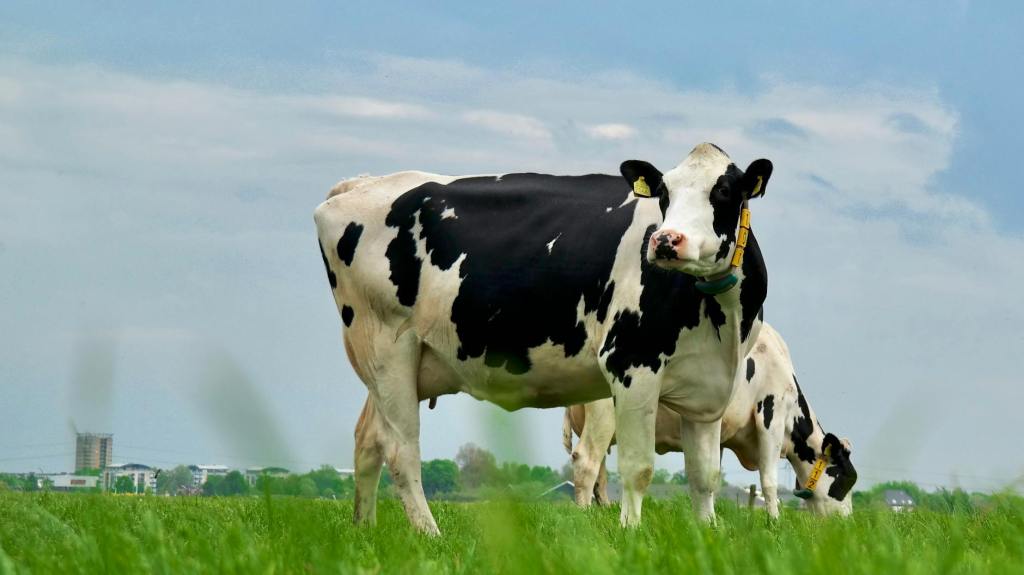
Scientists in Switzerland have discovered that cows could play an unexpected role in improving soil health and storing carbon — simply by eating biochar.
Biochar is a charcoal-like substance produced by heating organic material such as crop waste or wood in a low-oxygen process known as pyrolysis. This process stabilizes the carbon in the material, turning it into a highly durable form that can persist in soils for decades or even centuries. Because of its porous structure and condensed carbon content, biochar is widely studied for its ability to lock carbon in the ground, improve soil fertility, enhance water retention and potentially reduce greenhouse gas emissions.
A new study led by Swiss researchers has explored a novel delivery system for this carbon-stabilizing material: dairy cows.
In the controlled feeding experiment, eight dairy cows were given a diet containing small amounts of biochar — about 1% of their feed. The trial lasted for two 35-day periods. During the first phase, half of the cows received biochar while the other half were fed a standard diet. In the second phase, the groups were switched so that each cow served as its own control, strengthening the reliability of the findings.
Throughout the experiment, researchers collected dung samples over several days and analyzed them using three different methods to determine how much of the ingested biochar survived digestion. The goal was to assess whether the material remained structurally and chemically intact after passing through the cows’ complex digestive systems.
The results were striking. Between 70% and 90% of the biochar consumed by the cows survived their digestion process. Even more notably, approximately 98% of the recovered biochar fragments remained physically and chemically intact.
This means that most of the biochar retained its condensed carbon structure — a key feature that allows it to resist decomposition in soil. The stability of this structure ensures that the carbon contained within the biochar does not easily break down and return to the atmosphere as carbon dioxide.
Researchers did observe some variation depending on the type of biochar used. Biochar that was richer in oxygen content appeared to decompose more readily during digestion. This finding highlights the importance of biochar quality and composition in determining its durability inside the animal gut and, ultimately, its effectiveness as a soil amendment.
The implications of the findings are significant. If biochar can pass largely unchanged through cattle, it suggests that livestock could serve as natural dispersal agents, distributing the material across pastures through manure. Instead of manually applying biochar to fields — a process that can be labor-intensive and costly — farmers might incorporate it directly into feed, allowing cows to spread it organically while grazing.
Beyond carbon storage, biochar offers several potential agricultural benefits. When added to soil, it can improve nutrient retention, enhance microbial activity and increase water-holding capacity. Some previous studies have also suggested that biochar supplementation in cattle feed may reduce methane emissions from manure, further lowering the climate impact of livestock production.
Methane is a potent greenhouse gas, and cattle are one of its major agricultural sources due to their digestive processes. If biochar can help mitigate methane emissions while simultaneously sequestering carbon in soils, it could offer a dual climate benefit.
However, researchers caution that the concept remains experimental. Questions remain about long-term impacts, cost-effectiveness, optimal biochar formulations and potential regulatory considerations. Larger-scale trials would be necessary to determine whether this approach can be adopted widely across different farming systems.
Still, the findings add to a growing body of evidence suggesting that biochar could become an important tool in climate-smart agriculture. By combining carbon sequestration, soil restoration and potential methane reduction, the humble cow may one day contribute to a circular system where livestock help repair the land they depend on.
While more research is needed before this strategy moves into mainstream practice, the Swiss study presents an intriguing possibility, cattle not only as contributors to agricultural emissions, but as partners in building healthier, carbon-rich soils.
 PARYAWARAN
Leave a comment