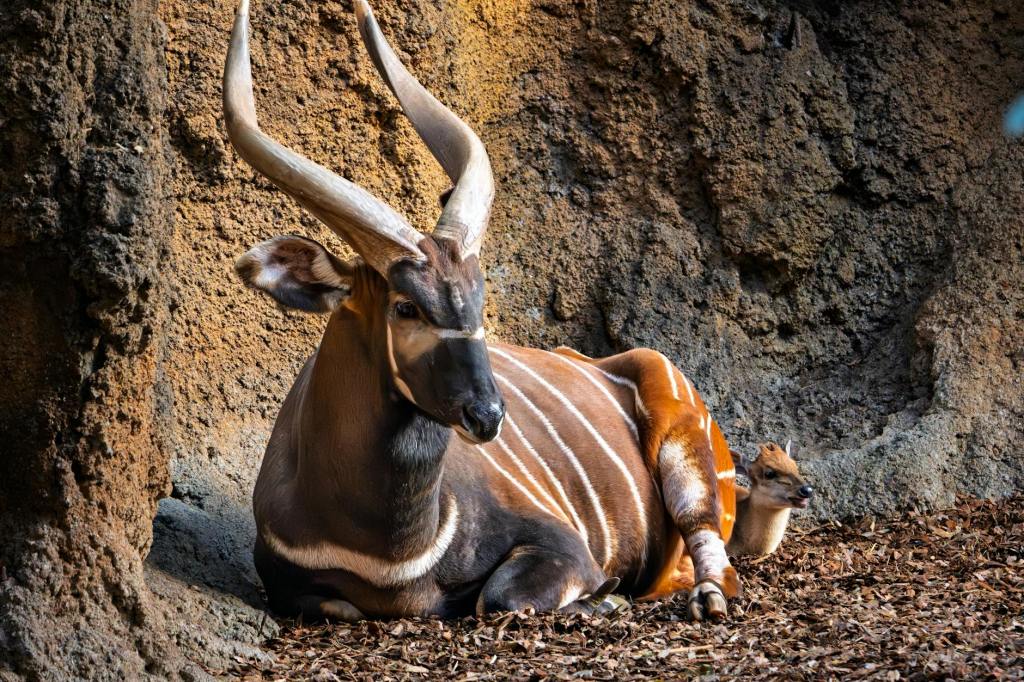
Deep within the mist-covered forests surrounding Mount Kenya, conservationists are working to restore one of Africa’s rarest antelopes to its native habitat. The critically endangered Mountain Bongo, often called the “ghost of the forest” because of its elusive nature and remarkable camouflage, is slowly making a return to the wild after decades of decline.
Once widely distributed across Kenya’s montane forests, the mountain bongo population suffered catastrophic losses during the twentieth century due to disease outbreaks, habitat degradation, poaching, and human encroachment. Today, fewer than 100 individuals are believed to survive in the wild, making the species one of the most endangered large mammals in Africa.
To reverse this decline, a large-scale conservation breeding and reintroduction programme has been underway at the Mount Kenya Wildlife Conservancy. Situated on the forested slopes near Mount Kenya, the conservancy has emerged as a critical centre for restoring the species. Spread across more than 1,200 acres, the facility houses captive-bred bongos and prepares them for eventual release into natural forests.
Conservation teams at the facility focus on rebuilding the animals’ natural survival instincts before reintroduction. The bongos are gradually conditioned to survive independently by learning to forage naturally, avoid predators, and adapt to forest conditions without human support. Their shy temperament and strong camouflage abilities are considered vital traits for survival in the wild.
The mountain bongo is easily recognizable by its chestnut-brown coat marked with striking white vertical stripes and long spiral horns. Despite its distinct appearance, the antelope is extremely difficult to spot inside dense vegetation. Its coloration blends perfectly with forest undergrowth, allowing it to disappear almost invisibly among shrubs and vines. This natural camouflage has earned the species its reputation as the “ghost of the forest.”
As part of efforts to strengthen the genetic diversity of the recovering population, the conservancy recently brought four male bongos from European zoological institutions. The animals are currently under quarantine and observation before being introduced into the breeding programme. Conservationists believe that introducing unrelated bloodlines is essential to avoid inbreeding and improve the long-term resilience of the species.
The current conservation population traces its origins to bongos that were exported from Kenya to the United States during the 1980s. At that time, wildlife experts feared the species might disappear completely from the wild and established captive breeding populations abroad as a safeguard against extinction. In 2004, descendants of those captive bongos were returned to Kenya, laying the foundation for the ongoing recovery initiative.
Since then, the breeding programme has grown steadily, with the conservancy now supporting more than 100 individuals. A major milestone was achieved in 2022 when the first group of captive-bred bongos was reintroduced into the wild forests of Mount Kenya. The success of the programme became even more evident with the birth of calves in the wild, indicating that the animals are adapting successfully to their natural habitat.
The mountain bongo is native to the forests of Mount Kenya, Aberdare, Eburu, and Mau landscapes. These montane forests are ecologically important because they serve as major water catchment systems supporting rivers, agriculture, and human settlements across Kenya. Conservationists emphasize that protecting the bongo also contributes to the preservation of these fragile forest ecosystems.
Despite encouraging progress, the recovery of the species remains slow and challenging. Mountain bongos have a long gestation period of about nine months and produce relatively few offspring. They are also highly sensitive to environmental changes, disease, and dietary variations. Compared to other antelope species inhabiting the same forests, bongos require more specialized habitat conditions and careful management.
To support their health, conservation teams supplement the animals’ natural diet of leaves, shrubs, and vines with specially prepared nutritious feed. Continuous monitoring is also carried out to assess movement, breeding success, behaviour, and adaptation after release into the wild.
The conservation programme has also helped increase awareness among local communities and tourists visiting the conservancy. Many residents who had previously only heard stories about the elusive antelope are now witnessing the species for the first time. The sight of the shy, striped antelope moving silently through the forest has become a symbol of hope for wildlife conservation in Kenya.
As efforts continue to restore the mountain bongo population, conservationists remain optimistic that the “ghost of the forest” may once again become a common presence in Kenya’s highland forests rather than a disappearing memory of the wild.


 PARYAWARAN
Leave a comment