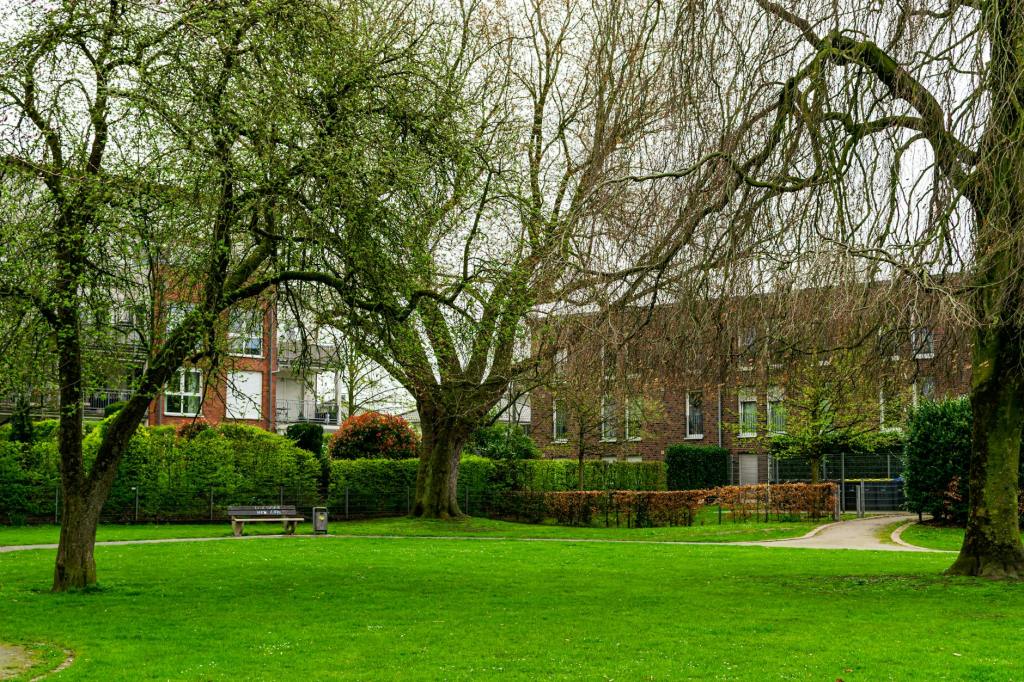
Trees are quietly helping cool the world’s cities, reducing nearly half of the extra heat created by concrete roads, buildings, and pavements. But a new global study has found that the places suffering the most extreme heat — especially poorer cities in developing nations — are getting the least benefit from urban trees.
The research, published in the journal Nature Communications, examined nearly 9,000 large cities around the world. Scientists found that urban trees lower temperatures by providing shade and releasing moisture into the air, helping offset the “urban heat island” effect. This effect occurs when dark roofs, asphalt roads, and dense construction absorb and trap heat, making cities much warmer than nearby rural areas.
According to the study, trees cool cities by an average of 0.15 degrees Celsius globally. Without trees, urban areas would be around 0.31 degrees Celsius hotter on average.
Researchers used satellite images, weather station data, and computer models to measure temperatures in small sections of cities, rather than averaging entire urban areas together. This helped them identify which neighborhoods actually benefit from tree cover and which do not.
The study found major inequalities between wealthy and poorer cities. In richer countries, many cities have enough tree cover to noticeably cool the environment. In poorer nations, especially in hot and dry regions, trees are sparse and offer little protection from rising temperatures.
Some cities, including Berlin, Atlanta, Seattle, Washington, Moscow, and Sydney, were found to have strong cooling benefits because of large tree canopies. Atlanta alone reportedly has about 64% of its land covered by trees.
In contrast, several large cities in hot regions receive almost no cooling from trees. Cities such as Dakar in Senegal, Jeddah in Saudi Arabia, Kuwait City, and Amman in Jordan have such limited greenery that millions of residents experience virtually no temperature relief from urban forests.
Lead researcher Rob McDonald of The Nature Conservancy said this imbalance reflects deeper social and economic inequalities. Wealthier communities often have larger homes, private gardens, and stronger political influence, making it easier to plant and protect trees. Poorer neighborhoods, meanwhile, tend to have fewer green spaces and higher population density.
The findings are worrying because extreme urban heat can seriously affect human health. Heat stress can confuse the brain, strain the heart, damage organs, and even lead to death during severe heatwaves. As climate change pushes global temperatures higher, cities are becoming increasingly dangerous for vulnerable populations.
Experts involved in the study stressed that planting more trees can still make a meaningful difference, especially in heat-prone urban areas. Trees not only cool the air but also improve air quality, reduce pollution, support biodiversity, and provide mental health benefits.
However, scientists also warned that trees alone cannot solve the climate crisis.
In many dry cities, water shortages limit how many trees can survive. Lack of land, poor urban planning, and unsuitable tree species also reduce the effectiveness of greening efforts. Researchers estimate that even with ambitious tree planting, cities may only be able to cut future urban heating by about 20%.
“Trees won’t save us from climate change,” McDonald said, emphasizing that reducing fossil fuel use remains essential.
Other scientists echoed the same concern. Jonathan Overpeck, dean of the School for Environment and Sustainability at the University of Michigan, said the world cannot rely only on tree planting while continuing to burn coal, oil, and gas.
Experts argue that cities need a combination of solutions — including renewable energy, better urban planning, public transport, cool roofs, water conservation, and expanded green spaces — to protect people from rising temperatures.
Still, the study highlights one clear message: urban trees are not just decorative. In a rapidly warming world, they are becoming critical infrastructure for human survival. But unless cities address inequality in access to green spaces, the people facing the harshest heat may continue to be left without relief.


 PARYAWARAN
Leave a comment