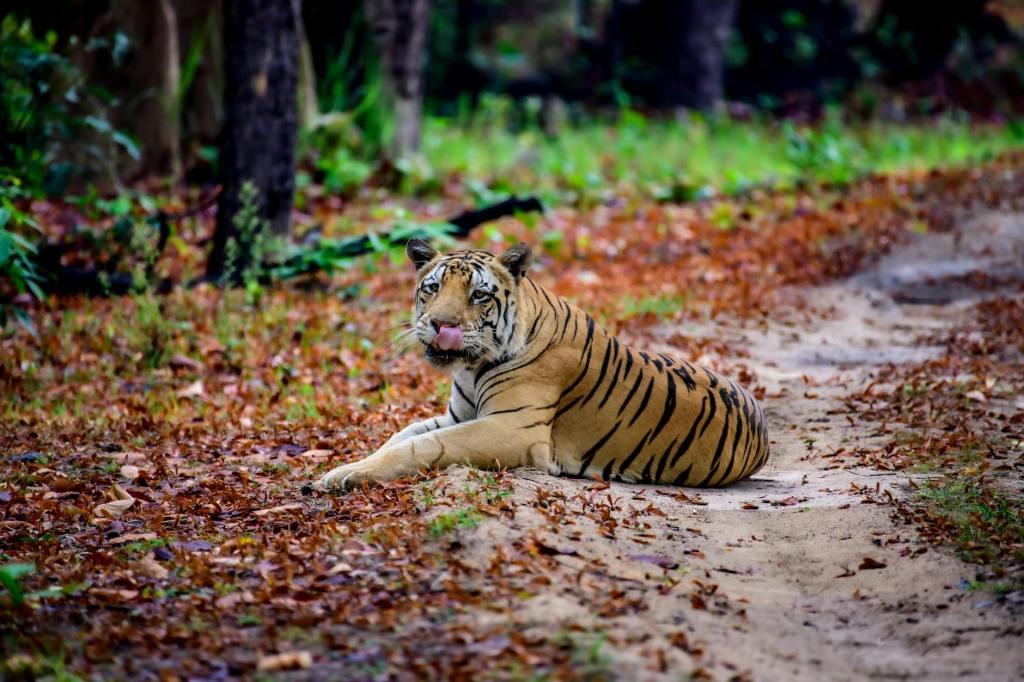
The Bihar government has announced plans to develop the Kaimur Wildlife Sanctuary (KWLS) as the state’s second tiger reserve, following the successful establishment of the Valmiki Tiger Reserve (VTR). The initiative comes in response to the significant increase in the tiger population within VTR, which has reached a record high of 54 tigers. This achievement highlights the success of conservation efforts in the region.
The National Tiger Conservation Authority (NTCA) recently granted in-principle approval for the development of KWLS as a tiger reserve. The Bihar government is now working on finalizing the necessary modalities for the sanctuary’s development and for the translocation of tigers from VTR to KWLS. This is an important step, as the current tiger population in VTR has approached its capacity, necessitating the need for additional habitat to support these majestic big cats.
Spanning an area of approximately 1,505 square kilometers, Kaimur Wildlife Sanctuary is situated in a geographically diverse landscape. It is bordered by several districts in Bihar, Jharkhand, and Uttar Pradesh, making it an ideal location for expanding tiger habitats. The sanctuary is home to a rich variety of wildlife, including leopards, sloth bears, chital, sambar, wild pigs, nilgai, and chowsingha, along with about 70 species of birds. These characteristics make it a suitable sanctuary for developing a tiger-bearing landscape.
Historically, tigers roamed the KWLS until the mid-1990s, as evidenced by records maintained by the Forest Department. The re-establishment of a tiger population in this area aligns with broader conservation goals, aiming to create sustainable ecosystems that support both wildlife and local communities.
The VTR, which covers a core area of 909.86 square kilometers, was designated as the 18th tiger reserve in India in 1990 and ranks fourth in the country in terms of tiger density. It is distinguished by its stunning natural features, including the Gandak and Masan rivers that flow through the reserve.
The development of KWLS as a second tiger reserve in Bihar reflects the government’s commitment to wildlife conservation and biodiversity protection. By expanding protected areas and enhancing wildlife habitats, the state aims to foster a healthy environment for both tigers and the diverse species that share their ecosystem, ensuring a thriving future for wildlife in the region.

 PARYAWARAN
Leave a comment