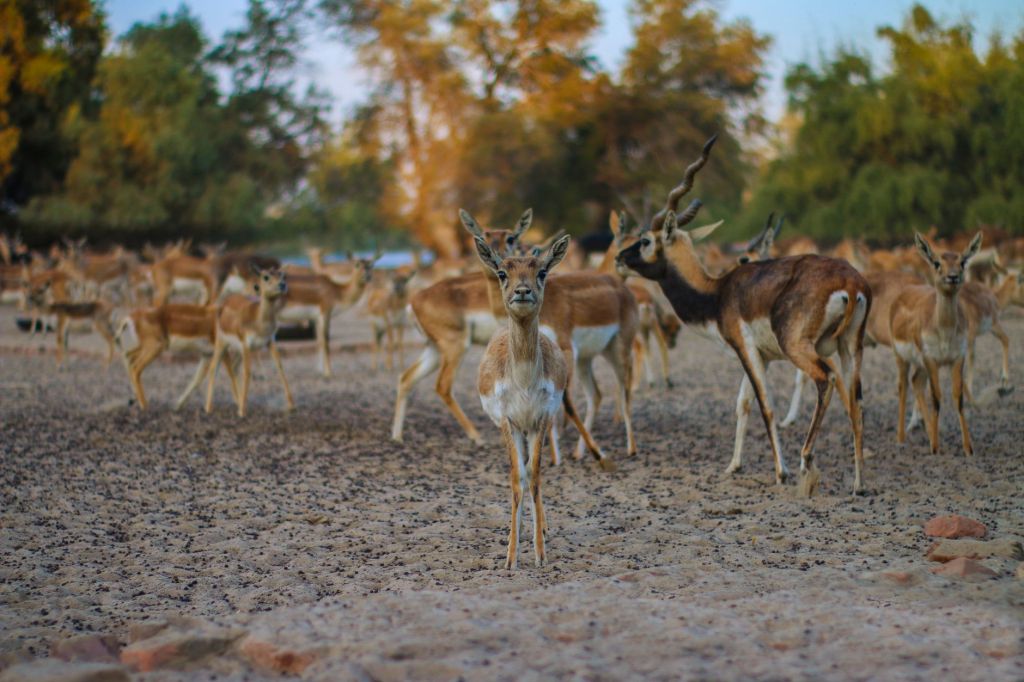
Standing Committee asks Madhya Pradesh to identify ecologically stronger compensatory sites before considering the proposed denotification of the 478 sq km protected area
The proposed denotification of the Bagdara Wildlife Sanctuary in Madhya Pradesh has entered a crucial phase after the Standing Committee of the National Board for Wildlife (SC-NBWL) directed the state government to explore alternative landscapes for compensatory notification before any final decision is taken. Rather than approving the proposal outright, the committee emphasized that any loss of a protected area must be offset by securing another landscape with stronger long-term conservation potential.
The issue was discussed during the SC-NBWL meeting held on July 9, where the Madhya Pradesh government presented its case for removing the protected status of the sanctuary, citing extensive human habitation, fragmented forests, and increasing developmental needs of local communities.
A Sanctuary Established for Blackbuck Conservation
Bagdara Wildlife Sanctuary, spread across 478 square kilometres in Singrauli and Sidhi districts, was notified in 1978 primarily for the conservation of the blackbuck, one of India’s iconic antelope species. Over the years, the sanctuary has also provided habitat to a variety of wildlife, including wild boar, sambar, jackal, fox, porcupine, striped hyena, and several bird and reptile species.
However, unlike many protected areas dominated by contiguous forests, Bagdara consists of a complex mosaic of forest and revenue lands. According to information presented before the committee, approximately 230 square kilometres comprise forest land, while nearly 246 square kilometres fall under revenue land.
The sanctuary also encompasses 64 revenue villages, supporting a human population of more than 32,000 people, making conservation management increasingly challenging.
Developmental Constraints Drive the Proposal
The Madhya Pradesh government informed the committee that implementation of the Wild Life (Protection) Act, 1972 has complicated developmental activities and land-related transactions within the revenue villages located inside the sanctuary.
Because statutory approvals are required for several infrastructure projects and land-use changes, residents have reportedly experienced delays in development and administrative processes. The government argued that these restrictions have generated dissatisfaction among local communities and have constrained economic growth in the region.
Officials further stated that Bagdara’s forest patches have become highly fragmented and are surrounded by villages and agricultural lands, reducing the sanctuary’s ecological effectiveness. Given these realities, the state proposed denotification as a means to facilitate development while redirecting conservation investments toward landscapes with greater biodiversity value.
NTCA Supports Ecological Assessment
The National Tiger Conservation Authority (NTCA) supported the state’s assessment of Bagdara’s current conservation status.
According to the meeting minutes, the authority observed that the sanctuary has limited long-term viability as a functional protected area because of extensive human habitation, fragmented habitats, and continuous developmental pressures. The presence of numerous villages within the sanctuary has significantly reduced habitat continuity, making wildlife management increasingly difficult.
The NTCA recommended that, if denotification proceeds, the state should simultaneously identify a compensatory landscape capable of delivering stronger conservation outcomes in the future.
SC-NBWL Recommends Alternative Protected Landscapes
Instead of immediately endorsing the proposal, the SC-NBWL advised the Madhya Pradesh government to examine alternative areas that could be notified as protected landscapes.
Among the options suggested was the Balaghat landscape, particularly the forests located east of Kanha Tiger Reserve between Kanha and Pench Tiger Reserves. Conservation experts consider this region highly significant because it functions as an important wildlife corridor linking two of central India’s most important tiger landscapes.
The committee also recommended evaluating the forested landscape between Sanjay Gandhi Tiger Reserve and Bandhavgarh Tiger Reserve. Strengthening protection in this corridor could improve habitat connectivity, facilitate wildlife dispersal, and support long-term conservation of tigers and other wide-ranging species.
Balancing Conservation with Human Development
The Bagdara proposal reflects a growing challenge confronting wildlife managers across India—balancing biodiversity conservation with the developmental aspirations of people living within protected landscapes.
Many protected areas notified decades ago include revenue villages and privately owned lands, creating administrative complexities as populations expand and infrastructure demands increase. At the same time, conservation scientists emphasize that denotification should remain an exceptional measure and should only be considered after ensuring that ecological losses are compensated through protection of landscapes with equal or greater conservation value.
By recommending alternative compensatory sites instead of immediately approving the proposal, the SC-NBWL has reinforced the principle that protected area rationalization must not come at the cost of biodiversity conservation.
What Lies Ahead
The Madhya Pradesh government is now expected to evaluate the suggested landscapes and identify a suitable compensatory area for consideration. The proposal will likely undergo further scrutiny before any final decision on Bagdara Wildlife Sanctuary is taken.
The outcome will be closely watched by conservationists, policymakers, and local communities alike. While the proposal seeks to address developmental concerns of thousands of residents, it also raises broader questions about the future of India’s protected area network, the importance of ecological connectivity, and the need to reconcile conservation goals with the realities of human-dominated landscapes.
The final decision on Bagdara Wildlife Sanctuary is expected to set an important precedent for how India approaches protected area denotification in the years ahead, particularly in landscapes where conservation priorities intersect with growing developmental pressures.

 PARYAWARAN
Leave a comment