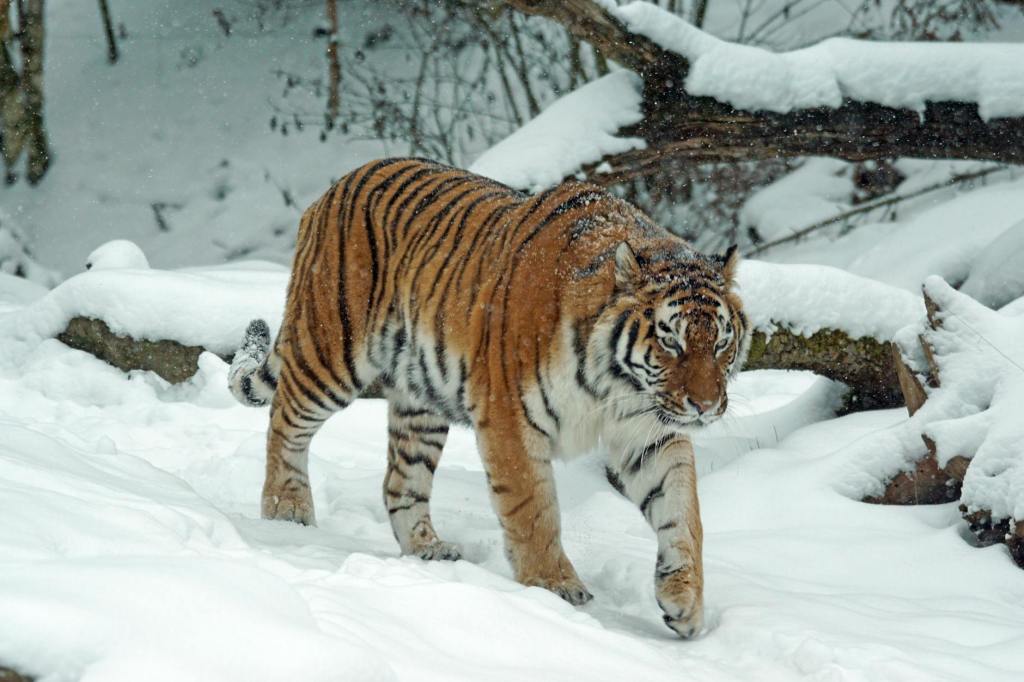
More than seven decades after wild tigers disappeared from Kazakhstan, a female Amur tiger has been released into the wild as part of an ambitious programme to restore the species to its historic range in Central Asia.
Named Umit, meaning “hope” in Kazakh, the tiger has become a symbol of Kazakhstan’s efforts to bring wild tigers back to a landscape where the extinct Turan tiger once roamed. Her release in the Ile-Balkhash Nature Reserve marks the first time a tiger has been released into the wild in Kazakhstan in more than 70 years.
Umit was one of four Amur tigers brought to Kazakhstan from Russia in May. Before being released, she spent two months under close observation, allowing wildlife experts to assess her physical condition, behaviour, hunting ability and capacity to survive independently.
Her release represents the beginning of a long-term conservation programme rather than an immediate return of a self-sustaining tiger population.
The adult male that arrived with Umit remains under observation as experts assess whether he is ready to enter the wild. Two younger tigers, which arrived in Kazakhstan at about six months of age, will remain under human care until they are approximately 18 months old.
The reintroduction programme has been designed in two stages. During the first stage, the tigers are kept in a large enclosed habitat where they can become accustomed to the local environment and develop the skills required for survival. The second stage involves releasing suitable animals into the wider Ile-Balkhash Nature Reserve.
Unlike many wildlife reserves, the protected area is not fenced. This allows released tigers to move freely through the landscape and use their natural habitat rather than being confined to a limited enclosure.
To track Umit following her release, conservationists fitted her with a GPS/GSM satellite collar. The technology will allow wildlife authorities to monitor her movements, habitat use and behaviour while also helping them respond quickly if she approaches human settlements.
Authorities have also established measures aimed at reducing potential conflict between tigers and local communities. Residents living near the reserve are expected to receive alerts if a tiger approaches within five kilometres of a village.
A dedicated response team has been established to deal with situations in which a tiger moves towards populated areas. Officials have stressed that protecting people living around the reserve remains a priority as the reintroduction programme progresses.
Rebuilding the tiger’s prey base
The success of the programme depends not only on the tigers but also on whether the reserve can provide enough natural prey.
An adult tiger may need to hunt approximately 50 to 70 large animals each year to meet its nutritional requirements. Kazakhstan has therefore spent years rebuilding populations of prey species in the Ile-Balkhash landscape.
Since 2018, conservationists have reintroduced Bukhara deer from Kazakhstan and Russia and relocated kulans from Altyn-Emel National Park. The restoration of these herbivore populations is intended to provide a stronger ecological foundation for the return of tigers.
The effort reflects an important principle of species reintroduction – “predators cannot be restored successfully without restoring the ecosystems and prey populations on which they depend”.
Why Amur tigers?
The programme is focused on Amur tigers because genetic research has established a close relationship between the Amur tiger and the extinct Turan tiger that once inhabited Central Asia.
The Turan tiger disappeared from the region more than 70 years ago as a result of habitat loss, prey depletion, hunting and other human pressures. Although the original population is extinct, the genetic similarity of the Amur tiger makes it a suitable candidate for restoring the ecological role of tigers in parts of their former Central Asian range.
Conservationists caution that the restoration process will take decades.
The programme will not be considered a success simply because individual tigers survive after release. A successful reintroduction would require the animals to establish territories, reproduce naturally and produce offspring capable of surviving without human assistance.
Building the next generation
Kazakhstan’s tiger restoration efforts also include two Amur tigers, Kuma and Bohdana, which were transferred from the Stichting Leeuw big-cat sanctuary in the Netherlands in 2024.
Unlike Umit and the other tigers brought from Russia, Kuma and Bohdana spent their lives in captivity and do not possess the experience needed to hunt and survive independently in the wild. They will therefore remain in a large enclosed habitat at the Ile-Balkhash Nature Reserve.
Their role is primarily connected to the programme’s breeding component.
If the pair successfully produces cubs and wildlife experts determine that the young animals have developed the skills required for independent survival, future generations could potentially become candidates for release into the wider landscape.
The approach combines wild-release efforts with controlled breeding to create a population capable of expanding naturally over time.
A decades-long conservation experiment
Umit’s release is therefore both a milestone and an experiment in ecological restoration.
If the programme succeeds, Kazakhstan could become the first country to restore a wild tiger population to a region where the species had become extinct.
But the road ahead remains challenging. Tigers require large territories, abundant prey and secure habitats. They can also come into conflict with people when their ranges overlap with settlements or livestock areas.
For now, Umit’s movements will provide valuable information about how a reintroduced tiger adapts to the Ile-Balkhash landscape.
Her GPS collar will allow conservationists to follow her journey across the reserve and assess whether the habitat can support a free-ranging tiger.
The return of Umit is therefore more than the release of a single animal. It represents an attempt to restore an ecological relationship that disappeared from Central Asia generations ago.
For Kazakhstan, the hope is that one tiger will eventually become the beginning of a self-sustaining wild population once again.


 PARYAWARAN
Leave a comment