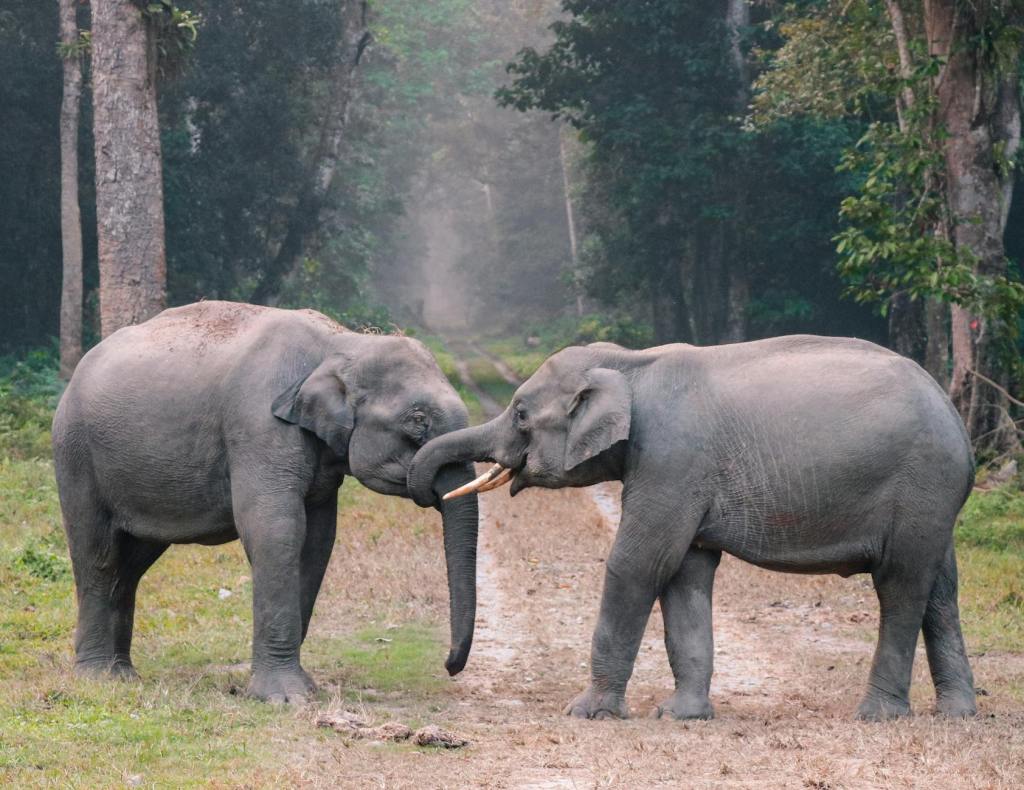
Fourteen years after World Elephant Day began, elephants remain caught between shrinking habitats, rising human-elephant conflict, captivity and conservation practices that sometimes reproduce the very problems they seek to solve.
Every year, World Elephant Day fills social media platforms, institutions, zoos, conservation organisations and government offices with familiar images of elephants accompanied by messages of love, respect and protection.
But beyond the photographs and campaigns lies a far more complicated reality.
Wild elephants are losing access to forests and movement corridors. Human-elephant encounters are increasing. Captive elephants continue to be used in tourism, religious ceremonies and festivals. Wild elephants involved in conflict are increasingly being captured, relocated or placed in rescue centres.
The contradiction is difficult to overlook.
Elephants are celebrated as intelligent, social and culturally important animals, while the landscapes they need are increasingly being reshaped for human use.
The celebration began with a different concern
World Elephant Day was launched in 2012 with a strong focus on the plight of elephants, particularly those living in captivity. The movement sought to draw attention to exploitation and promote the welfare of elephants while encouraging the return of captive animals to the wild where possible.
Since then, the campaign has developed into a global platform for raising awareness about threats to both wild and captive elephants.
Yet the problems facing elephants have become more complex.
Across Asia, elephants have occupied a unique place in human society for thousands of years. They have been worshipped, revered and incorporated into religious traditions, folklore and national identities. At the same time, they have been captured and trained for warfare, logging, construction, transportation, ceremonies and entertainment.
That history has never completely disappeared.
In several Asian countries, captive elephants remain part of tourism and cultural traditions. Elephants continue to be treated as economic and cultural assets even as conservation messaging portrays them as wild animals deserving freedom and protection.
Protecting elephants while fragmenting their habitat
The contradiction becomes even more apparent in the wild.
Governments and conservation organisations frequently highlight the importance of elephant corridors, habitat restoration and landscape connectivity. Yet the same landscapes can also be opened for mining, hydropower, roads, railways and other infrastructure.
For elephants, the consequences are significant.
As forests become fragmented and traditional movement routes are disrupted, elephants increasingly encounter farms, villages, roads and other human infrastructure. Communities living alongside them are then expected to absorb the costs of conservation.
Crop damage, property destruction, injuries and deaths can turn an otherwise protected species into a source of fear and resentment.
The response often focuses on managing the elephant rather than addressing the landscape that created the conflict.
When conflict management means capturing elephants
Across India, wild elephants involved in human-elephant interactions can be captured, driven away or relocated. In some cases, elephants may be removed even when establishing individual responsibility for particular incidents is difficult.
At the same time, trained captive elephants, or kumkis, are increasingly used in operations involving wild elephants.
The contradiction is stark.
A farmer accused of harming a wild elephant may face legal action, while government agencies can capture and train wild elephants as part of official conflict-management programmes.
The growing number of elephant rescue and rehabilitation centres adds another dimension. Such facilities can be vital for animals that are genuinely injured, orphaned or unable to survive independently. But their expansion also raises questions about whether captivity is gradually becoming a convenient response to a problem rooted in habitat loss and poor coexistence planning.
The changing role of mahouts
The traditional mahout system presents another complicated picture.
For centuries, mahouts have been responsible for controlling and managing domesticated elephants. The profession emerged from a system in which wild elephants were captured, broken and trained for human use.
Today, mahouts remain essential to the management of captive elephants. They are often publicly celebrated for their work with kumkis during conflict operations and for handling elephants participating in major religious and cultural festivals.
Yet the profession itself is under pressure.
Across parts of Asia, the traditional workforce is ageing, while fewer younger people are entering the profession with the specialised skills required to manage elephants.
At the same time, the expansion of elephant camps, rescue centres and festival programmes is increasing the demand for trained mahouts.
The result is an unusual cycle in which a traditional system of elephant domestication is simultaneously criticised, celebrated and expanded under modern conservation and cultural programmes.
Moving elephants instead of fixing the landscape
The problem becomes particularly visible when elephants cross administrative boundaries.
Several Indian states have attempted to push elephants back into neighbouring states when herds move into new areas. Such operations may offer short-term relief to local communities but do little to address why the elephants moved in the first place.
Some elephants have consequently been driven repeatedly between states, exposing them to unfamiliar terrain and communities and potentially increasing the likelihood of further conflict.
For a highly mobile species, political boundaries have little meaning. Forests, corridors and elephant landscapes do not stop at state borders.
Yet elephant management often does.
The numbers are becoming harder to ignore
The urgency is reflected in recent incidents.
During just the first six days of August, nine people were reported killed in human-elephant encounters, while one elephant was killed. Multiple ivory seizures were also reported across states, alongside numerous additional human-elephant interaction incidents.
At the same time, elephants are expanding into areas where they were previously less commonly recorded. Some populations have been documented at elevations exceeding 3,200 metres, demonstrating the species’ remarkable ability to adapt to changing environments.
But adaptation should not be confused with resilience without limits.
Elephants can alter their behaviour, change movement routes and explore new landscapes. Their intelligence and strong social bonds have helped them survive alongside humans for centuries. Yet every new adaptation can also bring them into contact with new threats.
What should World Elephant Day really celebrate?
After 14 years, the most important question may not be how widely World Elephant Day is celebrated, but what happens after the celebration ends.
Awareness has value. Public support for elephant conservation matters. But awareness campaigns cannot compensate for disappearing habitats, blocked corridors, poorly planned infrastructure, inadequate support for frontline forest staff or conservation policies that rely increasingly on capture and captivity.
The people living alongside elephants also need to be at the centre of conservation. Their livelihoods, safety and knowledge must be considered alongside the ecological needs of elephants.
Most importantly, elephants need landscapes where they can move, feed, reproduce and live without being repeatedly forced into conflict or captivity.
World Elephant Day was created to draw attention to the suffering and exploitation of elephants. Fourteen years later, that purpose remains relevant.
The celebration, however, risks becoming another annual ritual if it does not confront the uncomfortable contradictions surrounding elephant conservation.
Elephants do not need another day of admiration as much as they need secure habitats, functioning corridors, responsible development, meaningful coexistence and conservation policies that place their long-term welfare above short-term convenience.
The real test of World Elephant Day will therefore not be the number of campaigns, events or social media posts it generates.
It will be whether, after the celebrations fade, elephants are given more space to remain wild—and communities sharing that space are given a fairer chance to live alongside them.


 PARYAWARAN
Leave a comment