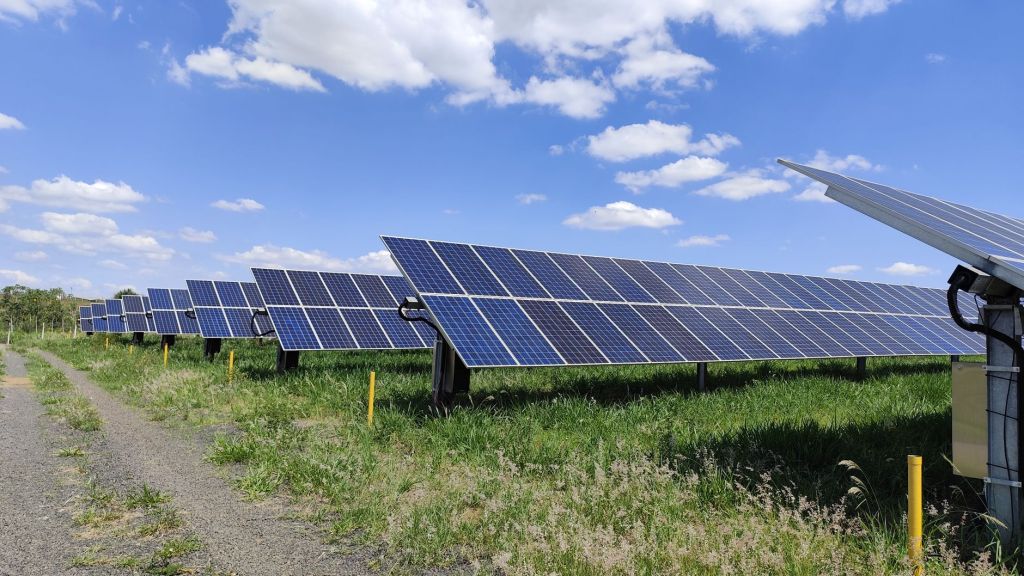
Switzerland’s pioneering solar railway project has demonstrated that railway tracks can serve as a new frontier for renewable energy generation, paving the way for similar installations across Europe and beyond.**
Europe’s transition to clean energy is extending beyond rooftops and solar farms to an unlikely location—railway tracks. A groundbreaking pilot project in Switzerland has shown that photovoltaic (PV) panels installed between active railway tracks can generate clean electricity without disrupting rail operations, opening up new possibilities for integrating renewable energy into transport infrastructure.
The project, developed by Swiss start-up Sun-Ways, marked the world’s first operational solar railway when it was inaugurated in Buttes, a village in Switzerland’s Val-de-Travers district. The pilot installation consists of a 100-metre stretch of railway equipped with 48 specially designed solar panels, capable of producing a combined capacity of 18 kilowatt-peak (kWp).
Initially conceived as a three-year experimental project, the installation has exceeded expectations within its first year of operation. According to the company, the system has functioned reliably, with no significant technical issues or extraordinary maintenance requirements. The encouraging results have strengthened prospects for converting the temporary trial into a permanent installation.
The concept behind the project is straightforward but innovative. Rather than occupying agricultural land or requiring additional infrastructure, the solar panels are placed in the unused space between railway tracks. This approach allows existing transport corridors to simultaneously serve as renewable energy generators while preserving valuable land for other purposes.
One of the primary questions surrounding the technology has been whether flat-mounted solar panels on railway tracks can produce electricity efficiently. Conventional solar installations are typically mounted at an angle to maximise sunlight exposure throughout the year. For example, studies indicate that solar panels installed in Spain perform best at inclinations of around 30 to 35 degrees, with annual energy losses of less than one per cent at an optimal tilt.
Despite being laid almost flat between railway tracks, Sun-Ways estimates that the reduction in electricity production is only around 10 per cent compared to optimally inclined installations. During its first year of operation, the pilot system generated approximately 16,000 kilowatt-hours (kWh) of electricity, roughly equivalent to the annual electricity consumption of an average all-electric household in the United Kingdom.
The success of the pilot has highlighted the enormous untapped potential of railway infrastructure. Switzerland alone possesses more than 5,300 kilometres of railway lines. If solar panels were installed across suitable sections of the national network, they would collectively cover an area comparable to around 760 football fields.
According to Sun-Ways, such a nationwide deployment could generate approximately one terawatt-hour (TWh) of electricity annually—enough to meet around two per cent of Switzerland’s total electricity demand. While this would not replace conventional power generation, it represents a significant contribution toward the country’s renewable energy targets without requiring additional land acquisition.
Safety has remained a major consideration throughout the project’s development. Railway environments expose infrastructure to constant vibration, weather extremes, dust accumulation and heavy mechanical loads. Industry experts, including the International Union of Railways, had previously raised concerns about the potential for solar panels to develop microscopic cracks, increase fire risks or create reflections that might distract train drivers.
To address these concerns, Sun-Ways designed reinforced solar panels capable of withstanding the demanding conditions of active railway operations. Each panel incorporates anti-reflective coatings that minimise glare, reducing any risk of visual distraction for train operators.
The company has also integrated monitoring sensors into the installation to continuously assess system performance. In addition, specially designed brushes attached to passing trains automatically remove dust and debris from the surface of the panels, helping maintain efficiency without requiring frequent manual cleaning.
According to Sun-Ways, the pilot installation has operated smoothly throughout its first year, requiring no special maintenance interventions beyond standard monitoring.
Currently, electricity generated by the Swiss pilot project is fed directly into the national power grid. However, the company is already developing systems that would allow future solar railway installations to supply electricity directly to railway substations or even power train traction systems. Such an approach could help rail operators reduce their dependence on external electricity supplies while lowering operational carbon emissions.
The successful demonstration has attracted growing international attention. Building on the Swiss experience, Sun-Ways has signed a collaboration agreement with an Italian business partner working closely with Rete Ferroviaria Italiana, the country’s national railway infrastructure manager. A pilot project in Italy is expected to be announced in the coming months.
Beyond Europe, the technology is also gaining traction internationally. The company has secured government approval for another solar railway installation in South Korea and is engaged in discussions with potential partners in the Netherlands, China, India and Singapore.
As countries accelerate efforts to achieve climate targets and expand renewable energy capacity, existing infrastructure is increasingly being viewed as an untapped resource. Railway networks, stretching across thousands of kilometres and already connected to electrical systems, offer a practical opportunity to generate clean energy without competing for agricultural land or natural habitats.
Although further testing and long-term performance assessments will be necessary before widespread adoption, Switzerland’s pioneering project has demonstrated that railway corridors can become productive energy assets while maintaining safe and efficient rail operations.
If replicated on a larger scale, solar railways could become a valuable component of Europe’s renewable energy strategy, transforming transportation infrastructure into dual-purpose networks that support both mobility and sustainable electricity generation.


 PARYAWARAN
Leave a comment